Wednesday, June 28, 2017

Chattin' 'bout contact precautions: Endemic?

It's been a quiet week out here on the edge of the prairie. Temperatures plunged into the 40s at night and the cooler breezes have been amazing - a nice change from the mid-90's in Geneva last week. I'd like to publicly thank SAS for losing my luggage for 4 days and especially the folks who still talked to me during the meeting. Four days in the same pants - reminds me of a doctor's white coat!

One of the topics that came up at ICPIC and on twitter after the various contact precautions posts and JAMA viewpoints was whether a pathogen's prevalence is an important criteria to use when deciding between types or levels of infection control interventions to implement. Put another way, should we treat common, ie endemic pathogens like MRSA, differently than outbreak or novel pathogens like CRE?

Of course, the first difficulty with answering this question is that endemicity is local, like politics. For example, MRSA is only endemic in certain parts of the US (we have little at the Iowa City VA vs the Baltimore VA) and MRSA remains rare in the Netherlands. Clostridium difficile is common everywhere, except that when we visited Vietnam last year, we heard that it is less common in SE Asia. So, we can agree that it would be difficult to write national guidelines or mandates for specific pathogens if endemicity is an important parameter.

Another question I have is how can we define an endemic threshold?  If we were concerned about MRSA, is it the proportion of clinical S. aureus isolates with mecA? Or would the threshold be set around some level of admission prevalence - say 10%? This might depend on the pathogen and such factors as the colonization to infection ratio.

Finally, I do wonder if using endemic thresholds for deciding whether to relax infection control interventions runs counter to the risk of transmission in our ICUs and wards. One of the most important risk factors in acquiring a pathogen, say VRE, is the colonization pressure (proportion of other patients colonized with the bacteria) on the unit. Doesn't it then follow that as a pathogen becomes "more" endemic, however defined, that the individual risk to the "negative" patient increases. We can agree that it is harder to eliminate a pathogen as it becomes more prevalent or endemic. Yet, elimination isn't the only or even primary goal of infection prevention - it is to protect the individual patients and populations in our hospitals. Usually, endemicity is beyond our control, as there are many outside factors that can impede our efforts. But I don't think we should use endemic thresholds in our decision making.

Of course, we still need to ask basic questions like does the intervention work? Is it cost effective? And to bring this back to contact precautions, I see little evidence that contact precautions are more effective in CRE or CDI control vs MRSA. I also don't see that mortality rates are much higher in those pathogens where we agree to use contact precautions routinely (e.g. CRE) and where there is debate (e.g. MRSA). So there must be other factors driving the decision making, like availability of effective antibiotics, but I don't think endemic thresholds should be one of them.

Tuesday, June 27, 2017

John Oliver on Vaccines

Of course, how could we not share another great John Oliver video that covers an ID topic even if it's NSFW. One of the more insightful sections starts around 6:00, where he admits he understands why people are afraid of vaccines, since they are "getting injected by a needle filled with science juice." He also describes antibiotics as "poison used to murder things living in you." Now wouldn't antimicrobial stewardship be easier if patients and physicians thought of antibiotics as poisons and not just magical pills that have few side effects? What if we treated antibiotics like cancer chemotherapies?

Monday, June 26, 2017

The burden of contact precautions

A perspective published in JAMA today (free full text here) takes another whack at contact precautions. In this piece, Dan Morgan, Dick Wenzel, and Gonzalo Bearman nicely lay out the arguments against the use of contact precautions for endemic MRSA and VRE.

One thing this paper did was to stimulate me to think about using the gloved/gowned encounter as the unit of analysis rather than the number of days of isolation, or the number of patients impacted. Doing so highlights the burden for healthcare workers. To that end, I looked at the data cited in the perspective and did some calculations.

In the paper, they note that universal gowns and gloves in the BUGG Study resulted in a decrease of 1 acquisition of MRSA for every 336 patient-days of the intervention. There were 4 room entries per hour (96/day) in the BUGG Study in the intervention arm. They also note that 19% of S. aureus acquisitions represent transmission events when analyzed by whole genome sequencing. And 1 in 3 patients who acquire MRSA will become infected.

Doing the math, we find that in order to prevent 1 MRSA infection in the ICU setting using universal gowns and gloves requires 514,449 "protected" (gowned/gloved) encounters. Now using contact precautions for patients with targeted pathogens only (as opposed to universally) would greatly reduce the burden of the intervention, but even if  it were reduced by a factor of 10, or even 20, the burden would remain extraordinarily high.

When you combine high burden with questionable effectiveness and the current focus on alternative interventions (like hand hygiene and chlorhexidine bathing), it's not surprising that contact precautions is increasingly viewed as a decrepit concept.

Friday, June 23, 2017

It's not about you. Really. Well, most of you

After my posts discussing construct validity and other issues with studies attempting to understand the effect of eliminating contact precautions, several folks expressed concern that I was specifically talking about their proposed study, published study, abstract or hospital.  Well, I can assure you that none of my recent posts are about your studies or hospitals. Well, expect one, but not the one you might be thinking about.

While it's true that there have been many notable back and forth discussions about contact precautions on this blog from its initiation, I greatly respect Dan’s and Mike’s right to implement infection control in their hospital, their way. For example, we might even agree that contact precautions reduce transmission of MRSA by a certain amount; however, they might decide that MRSA is rare enough in their hospital that contact precautions are not locally cost-effective. I might even agree. Others colleagues have been concerned that I’m commenting on their specific study including ones presented yesterday at ICPIC. Yet, I never attended the session where several studies of ESBL control methods were presented. Unfortunately, jet-lag prevented me from making the earliest session, so I can’t claim specific knowledge or concerns about those studies.

However, I will share what prompted my recent posts (and hopefully a few more). A few weeks ago I had the opportunity to hear about a planned study that will examine the effect of discontinuing contact precautions. This planned study is large, includes a diverse set of hospitals and has a randomized design. However, the study only plans to discontinue contact precautions in non-ICU settings and only track clinical cultures. So, in my opinion, the study has strong generalizability, good internal validity but very poor construct validity.

During the discussion of the planned study, I mentioned this issue. The PI on the study was very quick to say that sure, it's not a perfect study but isn’t some information better than nothing? Of course the PI knows that it is hard for other scientists to say no to that question. We all like data. However, in this case the answer is a resounding no. Any large study will have economic and other impacts. For example, one opportunity cost of funding a large study with poor construct validity is not funding another study that could have a stronger design. Additionally, if you aren’t measuring the outcome properly, how can you tell if your intervention is harming patients? This is a human subjects issue, potentially. So, hopefully they will add methods that can measure colonization on discharge or better yet track post-discharge infections.

There you have it. You can be assured that I wasn’t thinking about your study or hospital. Of course, I can’t promise the same in the future.

Thursday, June 22, 2017

Construct Validity and Infection Control Nihilism

As describe by Cook and Campbell (1979) there are four components of validity: internal validity, external validity, statistical conclusion validity and construct validity. Internal validity relates to whether there is a causal relationship between an exposure (e.g. contact precautions) and an outcome (MRSA infections) that is free of bias. Randomization is thought to improve internal validity through reduction in confounding associated with unmeasured factors. External validity describes the generalizability of the findings to other populations (quasi-experimental studies typically have higher generalizability vs RCTs). Statistical validity is concerned with covariation between exposure and outcome and strength of the association (e.g. Type 1 and Type II error). All types of studies can have high or low statistical validity – it is independent of study design.

Finally, construct validity describes whether a test measures what it claims to be measuring. For example, if you claim a person is ESBL negative, is she actually free of ESBL colonization or infection and will not develop an ESBL infection in the future. As you can see, without high construct validity, all the other components of validity are unimportant. If your study design or microbiological method is unable to detect ESBL properly, it is irrelevant if you’ve completed a cluster-RCT or whether your p-value is significant. Thus, validity theory defines construct validity as the primary concern, subsuming all other types of validity evidence.

Which brings me to studies claiming contact precautions don’t prevent MRSA, ESBL or VRE. Let’s think about MRSA. If an MRSA negative patient is admitted to a hospital with a 4 day length of stay. On average (normal distribution) that patient would be expected to acquire MRSA at the end of day 2. Thus, they would have to go from acquisition to infection over the next two days prior to discharge for most studies to prove she didn’t acquire MRSA. Would two days even be long enough for her to have a positive nasal swab? So, how sensitive are surveillance cultures or clinical cultures at detecting this event. I’d suggest not sensitive at all. Thus, to have strong construct validity in any study looking at the benefits of eliminating contact precautions, the study would have to track patients for a prolonged period of time (months) and in particular look at infections that manifest during subsequent admissions including those to long term care facilities.

So, before we can make claims about the benefits or lack of benefits of infection control interventions we need to design studies with high construct validity. I would suggest that our ability to respond to current MDR-bacterial pandemics will foremost depend on us designing studies with strong construct validity. Pathogens will continue to harm our patients until we identify methods to halt their spread. The current trend towards infection control nihilism that is manifesting with those eliminating contact precautions based on studies with poor construct validity and typically very poor statistical validity (underpowered) is harming our patients – often after they are discharged from our facilities.

Monday, June 19, 2017

Drip, drip, drip...

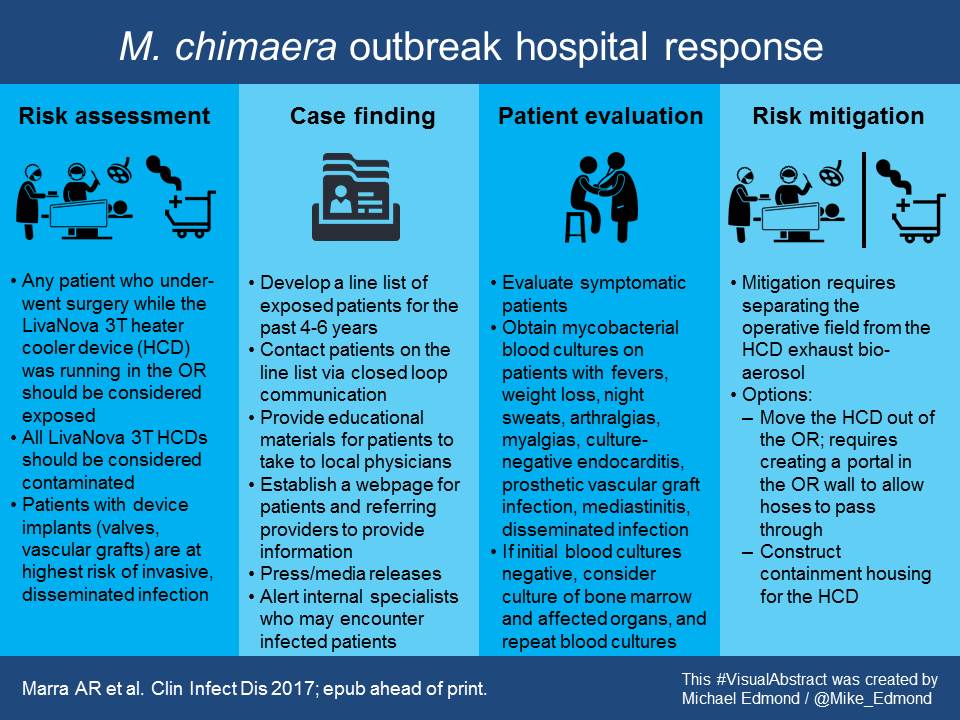
The global M. chimaera outbreak associated with heater cooler devices is still slowly evolving. We continue to learn of new cases through communication with clinicians. Yet the federal health agencies are mostly silent and many (perhaps most) hospitals using the implicated heater cooler devices have not developed a risk mitigation strategy. Thus, this outbreak is likely to stretch over a very long time. We recently published our experience with management of the outbreak in Clinical Infectious Diseases, summarized in the visual abstract below.


Sunday, June 18, 2017

Antibiotics: There's no free lunch

A new, important paper in JAMA Internal Medicine from Sara Cosgrove's group at Johns Hopkins demonstrates the collateral damage of antibiotics. In this retrospective cohort study of 5,579 internal medicine inpatients, 1,488 (27%) received a parenteral or oral antibiotic for at least 24 hours. The most common indication for antibiotics was UTI, Adverse events due to antibiotics were captured over the 30-day period after antibiotic initiation, with the exception of C. difficile infection and MDRO infections, which were captured over the ensuing 90 days. Median duration of therapy was 7 days. Of the patients treated with antibiotics, 19% had no clinical indication for antibiotic therapy, and 20% developed at least one associated adverse event. The breakdown of adverse events is shown in the visual abstract below (note: for this analysis, I combined the 30- and 90-day outcomes). We are becoming more cognizant that antibiotics are not benign therapies. Kudos to Sara and her colleagues for their work in raising our awareness.


OSHA! OSHA! OSHA!

  In many parts of the country, as rates of COVID-19 are declining and vaccination coverage is increasing (albeit with substantial variati...