Showing posts with label heater cooler units. Show all posts
Showing posts with label heater cooler units. Show all posts
Monday, June 19, 2017
Drip, drip, drip...
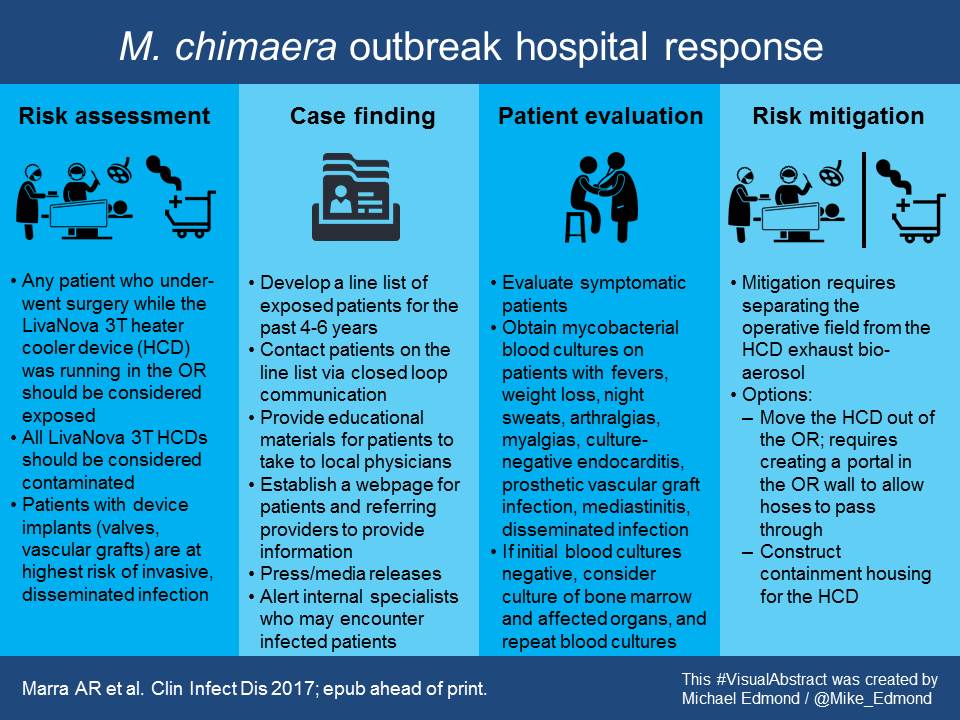
The global M. chimaera outbreak associated with heater cooler devices is still slowly evolving. We continue to learn of new cases through communication with clinicians. Yet the federal health agencies are mostly silent and many (perhaps most) hospitals using the implicated heater cooler devices have not developed a risk mitigation strategy. Thus, this outbreak is likely to stretch over a very long time. We recently published our experience with management of the outbreak in Clinical Infectious Diseases, summarized in the visual abstract below.


Sunday, April 30, 2017
Reducing risk from heater-cooler devices
We now know that heater-cooler devices (HCDs) are capable of producing bio-aerosols in the operating room (OR), and that these bio-aerosols can cause devastating infections. Obviously these devices must be re-engineered to eliminate bio-aerosol production, or replaced with other approaches to regulate the temperature of cardiopulmonary bypass machines and cardioplegia solutions. Until then, temporizing measures to eliminate risk from these faulty devices are needed.


We’ve already discussed our approach to removal of HCDs from the OR, and the approach they’ve used in Zurich (encasing the HCD in a stainless steel housing and venting the exhaust outside of the OR). At SHEA and ECCMID I saw interesting descriptions of two other approaches to separate the HCD exhaust from OR air.
First, at SHEA a group from Boston Children’s Hospital presented a “Wall Water System” that takes advantage of ready availability of hot and cold water supplies near to the OR, combined with a medical grade mixing valve to carefully regulate temperature. This allowed them to provide heating and cooling without the need for an HCD. An ECCMID attendee noted that this approach has also been initiated at one or more hospitals in Europe. See the image below for the full poster (sorry for image quality, it’s my own iPhone pic!).

At ECCMID, John Conly from Calgary presented their experience with contaminated HCDs, and their approach to placement of the HCD within an enclosure that included the OR exhaust vent that was drawing the HCD exhaust out of the OR. Their poster is below.

I’m most intrigued by the first approach: using existing hot and cold water supplies, along with precision mixing valves, to eliminate the need for a free-standing unit in the OR that exists solely to regulate the temperature of a water reservoir.
Sunday, January 22, 2017
M. chimaera update: SHEA webinar

Tomorrow (Monday, January 23 at 1 pm Eastern Time), Mike and I will be presenting an update on the global outbreak of heater-cooler device associated Mycobacterium chimaera. You can sign up for this SHEA webinar here (sorry for the late notice!). A CDC representative will join us for the Q&A. Once it is done we'll either post a link to the webinar or make the slides available on the blog.
We hope you can join us!
UPDATE: here is the link to listen to the webinar.
Wednesday, November 2, 2016
The M. chimaera How-to Guide
A few cases at a time, the M. chimaera outbreak associated with heater cooler units continues to grow. For reasons unclear to me, the response from CDC and FDA to this train wreck in slow motion has been underwhelming. We continue to field calls from hospitals struggling to deal with an approach to the outbreak. On today’s IDSA list-serv (IDea Exchange) Dr. Luther Rhodes wrote: “The silence is deafening. I call on those physicians with hands on experience in evaluating post open heart patients referred to ID for evaluation of concerns, signs or symptoms of possible NTM infection to speak up loudly and clearly. Lessons learned, protocols developed, evaluation and testing tools learned dealing with large scale regional patient notification should in my opinion be shared…”
We have posted several times on this topic, but I thought it might be useful to summarize how a hospital could approach this problem in a single post. To view older posts, type chimaera in the search box in the top right hand corner of your display.
Step 1: Determination of risk
Whether you have seen a case or not, the first question is whether your hospital has used the LivaNova Sorin T3 heater cooler unit (HCU) in the last six years. If the answer is no, there is no immediate action you need to take. If yes, then the investigation begins, as you must assume the units are contaminated, regardless of the manufacturing date.
Step 2: Risk mitigation
If you are currently using the LivaNova (Sorin) T3 unit, the most important risk mitigation strategy is to get the units out of the operating room. The molecular epidemiology clearly points to contamination of the HCUs at the manufacturing facility, which allows the units to produce an infectious bioaerosol that contaminates the operative field. Separation of this bioaerosol from the operative field is the key to eliminating the risk. Why the FDA won’t clearly state this is very puzzling.
At the University of Iowa Hospitals and Clinics our engineers were able to quickly (within a few days) devise a solution by creating a 6” x 6” hole (see photos) through the operating room wall on the semi-restricted side of the room. The area identified for creation of this portal was determined by hose access to the OR table with minimal interference with staff and equipment; access to power; and the ability to leave proper corridor width per life safety code. Testing demonstrated that positive pressure was able to be maintained in the OR after creation of the portal. The portal itself with a sliding door was constructed of Corian in some cases and stainless steel in others. A hose protection mat was placed in the ORs to protect the HCU hoses and to provide a ramp effect for equipment to be relocated as needed during the cases. One advantage of the T3 HCU is that remotes can be purchased that allow the perfusionist in the OR to control the HCU located outside of the room. Once the HCUs were moved out of the OR, we demonstrated no difficulty with appropriate heating or cooling. Remember, given the long incubation and detection period of these infections (maximum 6 years to date), if you do not eliminate the risk now, you will likely be chasing cases for many years with no end in sight.


Thursday, October 13, 2016
An outbreak in slow motion

Now, over a year since Hugo Sax and his group first described the role of HCDs in invasive M. chimaera infections, this may be about to change. Why? Because today the CDC published (in MMWR) the results of whole genome sequencing from 11 patients and 5 HCDs in Iowa and two centers in Pennsylvania (the Iowa isolates were from our patients and devices). The results confirm what we’ve suspected from the beginning: this is a point source outbreak, and the likely source is the factory in Germany where the HCDs are manufactured. There are now several media outlets that have picked up the story (here's one from NY Times and one from Consumer Reports).
In response to these findings, both CDC and FDA are making new recommendations for centers that use the implicated HCD (the LivaNova (formerly Sorin) 3T). You can read the details for yourself, but the major new recommendations are for provider and patient notification (not just for centers that have detected cases, but for all that use the devices), and from the FDA, a recommendation to remove any HCDs linked to contamination or clinical cases, and to transition away from use of the 3T model entirely (the alert states that use of 3T units manufactured prior to September 2014 “should be limited to emergent and/or life-threatening situations if no other heater cooler devices are available”).
The problem is that the 3T has at least 60% of the HCD market, and if all hospitals stopped using them (even just those manufactured prior to September 2014), there wouldn’t be enough other units to fill the void. Also important to note: the FDA alert provides evidence that some 3T’s manufactured after September 2014 have been found to be contaminated with M chimaera. Whether the post-2014 contamination represents point-source contamination or not, it’s a huge problem and calls into question the use of the manufacture date in decision-making.
The bottom line is that the 3T is a proven bio-aerosol generator, and should not be in the same room as the operative field. No amount of focus on cleaning and disinfection, the direction of the exhaust fan, or the results of water cultures (which, as we’ve pointed out, are not actionable) changes that.
Tuesday, October 11, 2016
CDC Webinar on the M. chimaera outbreak
The CDC has just posted a webinar from late August on the M. chimaera outbreak, if you are interested in an overview. It may be worth your while to look at this (or read our prior posts) this week, in anticipation of some additional information that will be coming soon (more details later this week).
The video below starts with introductions to the problem by Mike Bell and Joe Perz at CDC, than at 18:00 you can hear Chuck Daley from National Jewish discuss the clinical aspects of the outbreak, at 30:00 I discuss the local outbreak response, and at 46:00 Keith Allen provides a surgeon's perspective.
The video below starts with introductions to the problem by Mike Bell and Joe Perz at CDC, than at 18:00 you can hear Chuck Daley from National Jewish discuss the clinical aspects of the outbreak, at 30:00 I discuss the local outbreak response, and at 46:00 Keith Allen provides a surgeon's perspective.
Sunday, October 2, 2016
The ineradicable Mycobacterium chimaera

Peter Schreiber and colleagues from Switzerland report their experience trying to eradicate M. chimaera from their heater cooler units (HCUs) using an intensified cleaning and disinfection protocol (daily water changes using Pall-filtered tap water and 3% hydrogen peroxide, with biweekly 3% sodium hypochlorite (aka bleach) or paracetic acid disinfection). I’ve included part of their Figure 2 above: “No” means negative culture, “Yes” with a solid circle indicates M. chimaera growth, empty circles are other non-tuberculous mycobacteria. As you can see, M. chimaera persisted despite this intensified regimen, and cultures frequently skipped between positive and negative (and back again). This study nicely demonstrates the ineradicable nature of M. chimaera colonization in these Sorin 3T units, as well as the poor negative predictive value of a single set of HCU water cultures. Not only does a negative culture not reassure, but it takes 6-8 weeks to return—so cultures are not actionable for management of individual HCUs.
Another interesting tidbit from this article: a photo of the “housing unit” that they built to separate the HCU exhaust air from OR air and funnel it directly to the OR exhaust system (see Figure below from their article).

Finally, take a minute to read the best recent news article about this outbreak, from David Weissman at the York Dispatch. I continue to be astonished at the relative lack of media interest in this slow-motion train wreck, but in this piece the reporter clearly understands the potential ramifications of this problem, and touches on a key point: why hasn’t there been more attention to patient notification for those who were exposed to HCUs that we now know were contaminated when they left the factory?
More updates soon, as some interesting sequencing data will likely be published later this week…
Monday, June 20, 2016
The unfolding M. chimaera debacle: June 2016 update

Release of an FDA Safety Alert regarding the Sorin 3T HCU: In this alert, the FDA references the Eurosurveillance study we recently discussed, recognizing the evidence for factory-source contamination of 3T units, stating that “if your facility purchased and used a 3T prior to September 2014, be aware that the units may have been shipped from the factory contaminated with M. chimaera”. FDA now recommends all such facilities (1) inform surgeons about their patients’ infection risk, and (2) “determine a method for patient follow-up and establish patient surveillance” (per CDC recommendations).
Do you know if your hospital uses the 3T units? If so, are you alerting clinicians and working on a surveillance approach?
Meeting of the FDA Circulatory System Devices panel (June 2-3, 2016): During this meeting, the risks of bio-aerosol generation by HCUs were discussed at length. Slides and other materials from this meeting are here. Although all slide sets are available at this site, a quick 24-hour summary is here. Here are a few of my own random observations from this meeting:
- Awareness of this issue is still very limited, a point made by several panel members who should have already heard about fatal infections linked to HCU bio-aerosol generation. Broader notification is needed.
- HCU models differ dramatically in their design, and in their risk for production of aerosols (for example, the range of air movement by the HCU fans is an astonishing 20->700 cubic feet of air per minute, and the location and containment of the water source also varies).
- Routine culturing of HCU water for mycobacterial contamination isn't particularly useful and will likely not be recommended outside of outbreaks or clusters of infection. Only a small number of labs can do the cultures properly, negative results can be falsely reassuring, and the cultures take 8 weeks to return. Our own experience confirms this--we've had consecutive samples from the same unit yield different results, as have others. However, routine bacterial cultures ("heterotrophic counts") will continue to be recommended as a monitor for effectiveness of disinfection.
- No obvious near-term solution is evident. Replacement or recall of all 3T units is not possible given that it has 60% market share, and the panel felt that removal of the HCUs from the OR is not practical (despite the fact that some EU countries have done so). A rapidly-implementable engineering solution is desperately needed.
Thus there are undoubtedly many M. chimaera-contaminated 3T units being operated inside ORs, which really is an untenable situation. If your hospital can’t engineer a solution to remove this device from the OR (or otherwise separate the 3T HCU exhaust air from OR air), then you should seek to replace them with other makes/models not linked to this global outbreak.
Publication of the first US case series of invasive M. chimaera infections. Three cases have been reported from Mayo Clinic, preprint available from OFID here. The cases have similar clinical presentations to those reported already from Europe, and larger case series are undoubtedly to follow. Notably, two of the three patients in the Mayo series died, and the third (a 66 year old with aortic graft infection) is being treated medically due to the risk of graft replacement.
Based upon what I’ve heard from other clinicians caring for these patients, I propose this as an open question: once a patient has a device-associated invasive/systemic infection due to M. chimaera, is cure possible? Given the very long incubation period for this syndrome, this question is not currently answerable. The criteria for cure would require 24+ months without symptoms (and with negative cultures), after device replacement and 18 months of therapy. Stay tuned.
Image: The Chimaera of Arezzo
Monday, May 23, 2016
Finally, the outbreak of meetings!

Well, the FDA is hosting a meeting on this problem, details of which can be found here. I will be presenting about our experience at Iowa, but others with more expertise will be there as well, from US and Europe. I’m hoping to come away with a better sense of the way forward, which in my view must address (1) better case finding: improved clinician awareness via national patient and provider notifications, so that clinicians everywhere recognize exposure to cardiopulmonary bypass as a risk factor for disseminated MAC infection among patients with implants (valves, grafts), and creative approaches to identify potential cases who currently carry other diagnoses (e.g. sarcoidosis); (2) improved management of existing cases: we desperately need more clinical information about management approaches and outcomes, to help guide decision making for patients and their physicians; and (3) prevention of additional cases: the HCU has been revealed to be a bioaerosol generator that is too risky to share air with an open chest—the make/model implicated in this particular outbreak must obviously be removed from ORs, and other devices that include fans and water sources should also be scrutinized for the risk they may pose.
Thursday, April 28, 2016
More data support a common source for the M. chimaera outbreak

Another piece of the puzzle was published today by Haller and colleagues in Eurosurveillance. Read the whole thing for details of the German outbreak investigation, but the key additional findings are in the table above—brand new HCUs, and the water source at the manufacturing facility, grew M. chimaera. The genome-sequencing results are not included in this report, but read this key paragraph from the discussion below:
"Preliminary typing results indicate that the M. chimaera isolates detected by the authorities and the isolates from the manufacturer appear to be almost identical (unpublished data). The M. chimaera-positive environmental samples at the manufacturing site prompted the manufacturer to modify the manufacturing process, which now includes ethanol disinfection and an active drying of the HCU water circuit before shipment. ……According to the information provided by the manufacturer, HCUs manufactured before mid-August 2014 may have had environmental mycobacteria presence in the unit at the time of delivery [emphasis mine]. Our investigations could not elucidate if and until when contaminated HCUs may have been delivered to customers from this manufacturer."
It is, of course, impossible to know for how long units were shipped “pre-contaminated” from this manufacturing site to users, but this now-published information only increases the rationale for removal of these HCUs from the operating room. Both Dutch and German authorities took this step, as the authors note. The US should as well—it shouldn’t take long to determine the impact on HCU function of extending the tubing sufficiently to allow this.
Thursday, April 14, 2016
Mycobacterium chimaera update: A “must listen” from ECCMID

Fortunately, Dr. Jakko van Ingen gave an excellent talk at ECCMID that answers several important questions we’ve had about this outbreak, confirming some of the things we’ve heard (“in confidence”, I assume for political or legal reasons) on various conference calls and email strings. I urge you to take 30 minutes of your time to listen to his talk, all the way to the end of the Q&A period.
Aside from being an extremely entertaining speaker, Jakko addresses several key questions, including:
- Is this a clonal outbreak? YES. Slide 29 reports whole genome sequencing data that clusters the isolates from Sorin 3T units and infected patients (within just 2-3 SNPs), and further discussion (during Q&A session) confirms that isolates from other European countries are also in this cluster.
- Were the HCUs already contaminated prior to being shipped to end users? YES. Listen carefully to the last question and answer.
- Does this particular outbreak primarily involve one make/model of HCU? YES. While nontuberculous mycobacteria have been isolated from other types of HCUs, the specific M. chimaera cluster in this case involves Sorin 3T units.
- Is the invasive, disseminated, high crude mortality form of the illness restricted to those patients with implants (e.g. valves, grafts)? YES. The life-threatening disseminated infection appears to require some prosthetic material to which the organism can adhere, protecting itself (via biofilm formation) from host defense. According to Dr. van Ingen, case finding in the Netherlands is now limited to those with implants, and does not include standard non-valve, non-implant CABG patients.
- Is it possible to mount an effective, rapid national response to this urgent problem? YES. Slide 18 details the Dutch response, which involved discontinuing all non-urgent cardiac surgery until HCUs were placed outside of ORs (which was done within 48 hours). As we learned here when we did the same thing, it is amazing what you can accomplish when you are left with no other option.
- Is opening up a Sorin 3T HCU a frightening experience? YES. I’m sure I’ll have nightmares about these water-stained, biofilm-befouled devices for a long time (see below for one image from Garvey, et al).

What are the implications?
- HCUs are not safe to operate in an OR. The air exhausting from the HCU ventilation fan must be physically separated from the air in the OR, and the easiest way to do that is to remove them from the OR (and maintain the OR at positive pressure, of course).
- Everyone using Sorin 3T HCUs should assume that they may have exposed patients to M. chimaera, until more is known about the details of the point-source. Contaminated units cannot be disinfected even with the more intensive protocols currently recommended. In addition, only a few labs are capable of properly performing NTM cultures of water samples, so negative water cultures are of limited value and could be falsely reassuring.
- A much more active national patient and provider notification is needed. Our experience is similar to that of others: identified cases would never have been found had it not been for aggressive and active case-finding. There are undoubtedly others currently being treated with immunosuppression for sarcoidosis or some other “granulomatous process of uncertain etiology” who actually have undiagnosed disseminated M. chimaera disease.
Below I've pasted an epidemic curve of non-tuberculous mycobacteria (NTM) cases linked to HCUs (inclusive of M. chimaera, but also isolates not identified to species level and other NTM such as rapid-growers), including cases reported to FDA from US (blue bars) and abroad (red). This outbreak isn't over, and the fact that there are still hospitals performing cardiac surgery with their Sorin 3T HCUs inside of the OR is extremely distressing.

Sunday, February 28, 2016
The link between M. chimaera and heater cooler units grows stronger
A new paper in the Journal of Hospital Infection from Germany confirms the work of Hugo Sax and colleagues in Switzerland on the aerosolization of M. chimaera by heater cooler units. These investigators cultured M. chimaera from the water tanks of 4 Sorin heater cooler units, and were able to culture the organism from the air in the operating room only when the units were turned on. They were also able to culture non-fermenters from the air up to 10 feet from the heater cooler units when the units were turned on, but not when they were turned off. Importantly, the investigators were not able to culture M. chimaera from the hospital's water supply. And the authors note that whole genome sequencing of clinical and environmental isolates from the Netherlands and Germany suggests the possibility that the heater cooler units are intrinsically contaminated (i.e., this is a point source outbreak).
Lastly, the authors state that "only strict separation of the heater cooler unit from the operating room appears to enhance patient safety." We agree and that is the mitigation strategy that we have used at the University of Iowa. Below are photographs of our engineers' solution, a 6 x 6 inch Corian portal through the wall of the operating room, so that the heater cooler units are housed outside of the OR. The door is light weight and closes fully when the heater cooler device is not needed, and partially when the heater cooler hoses are extending through the wall. Positive pressure in the OR is maintained when the portal is in use.
 Dan and I have spoken with a number of physicians from across the country, and we are now aware of 18 M. chimaera infections in patients who have undergone cardiopulmonary bypass. All of these patients, with the possible exception of 1 patient, had a prosthetic valve or vascular implant placed. So patients with implants are most important if a look back needs to be performed for case finding.
Lastly, the authors state that "only strict separation of the heater cooler unit from the operating room appears to enhance patient safety." We agree and that is the mitigation strategy that we have used at the University of Iowa. Below are photographs of our engineers' solution, a 6 x 6 inch Corian portal through the wall of the operating room, so that the heater cooler units are housed outside of the OR. The door is light weight and closes fully when the heater cooler device is not needed, and partially when the heater cooler hoses are extending through the wall. Positive pressure in the OR is maintained when the portal is in use.

Saturday, February 20, 2016
M. chimaera transmission in the OR: Progress from Switzerland
Hugo Sax and his colleagues first reported the link between heater-cooler units (HCUs) and an outbreak of invasive Mycobacterium chimaera infections, and today they published a follow up investigation that strongly supports their hypothesis regarding mode of transmission.
I encourage you to read the article for yourself, but it describes a set of experiments using smoke dispersal and particle counts to demonstrate that the HCU tested (Sorin Model 3T) both dispersed smoke and increased particle counts over the surgical field in a OR with ultraclean airflow ventilation (also known as laminar flow). As would be expected, the dispersal of smoke and particles was greatest when the unit exhaust was oriented toward the surgical field, but higher particle counts were noted even when the exhaust was oriented away. Finally, settle plates were used to show that M. chimaera could be isolated up to 5 meters away from a contaminated HCU while it was in operation (this experiment was performed in a non-ventilated test room, so in essence determined how far the aerosols carried when no air currents were being generated (other than by the HCU itself).
The video below shows how smoke dispersal through the HCU was carried by the OR ventilation system to directly over the surgical field (scary!).
The authors point out that airflow systems designed to keep OR air clean may fail to protect against, or paradoxically contribute to, the dispersal of HCU exhaust over the surgical field. While I find this an interesting explanation for why some patients may be at higher risk for exposure and infection than others, the main story here is still that there is a device in the OR that produces a microbial aerosol:
“Heater–cooler units are stand-alone devices that contain a tank that holds filtered tap water, which serves as transfer fluid to control the temperature of patient blood and cardioplegia solution……The tank features filling and overflow tubes, heating and cooling coils, probes, and stirring devices. It is not airtight [emphasis mine]. The space beneath the tank holds a radiator to dissipate superfluous heat produced through water cooling. The efficacy of this radiator is increased by a fan that ensures a constant airflow through ventilation grid openings on either side of the heater–cooler unit housing.”
In short, this HCU seems designed to produce contaminated aerosols once it becomes colonized. Thus the only two options are to get the units out of the OR, or find a way to keep them clean. On this point, there is another key tidbit from this article:
“…M. chimaera has regrown in some of the monthly water cultures from most factory-new heater–cooler units delivered in January 2014 after 1 year of operation on a daily water-change with filtered tap water scheme…”
This is consistent with what we’ve learned from others dealing with this issue: there seems to be no reliable way to keep these units free of contamination, or to decontaminate them once they are contaminated.
Thus the most important sentence in this article is the last one:
“…all heater–cooler units should be reliably separated from air that can gain access to sterile areas and instruments...”
How to accomplish this is the current challenge: we took the approach of removing the units entirely from the OR, while the authors report that “their exhaust air is now captured by a secondary housing and reliably channeled to the operating room exhaust.”
Until a better-designed (i.e. safe) HCU is widely available, hospitals are in dire need of guidance about how to eliminate this insidious risk to their patients.
Wednesday, February 17, 2016
M. chimaera update
 |
| Big Sky, Montana |
While we continue to work on case finding at the University of Iowa, we continue to receive calls from physicians across the country asking for advice. One of the major problems is the paucity of data to guide recommendations for the best approach to outbreak investigation.
We need CDC and FDA to expedite the needed work to answer many questions. At this point, there is no published descriptive epidemiology of the cases in the United States. There's still no information on molecular typing of the patient and environmental isolates to sort out whether this a point source outbreak with contamination occurring during the manufacturing process of the heater cooler devices. Every hospital working on this issue is struggling alone in the dark, while it's becoming increasingly clear that this is an expanding outbreak.
Today we learned that a class action lawsuit has been filed against Sorin, the manufacturer of the implicated devices.
We'll post more on this topic as it unfolds.
Saturday, February 6, 2016
Insidious

In this post I want to raise three questions about this situation (note that I say “raise”, not answer):
1. Why M. chimaera?
Why is this particular, uncommon species from within Mycobacterium avium complex (MAC) causing infections in multiple countries in Europe and multiple states in the U.S.? If the cause of this outbreak were simply a faulty heater-cooler unit (HCU) design that allows whatever water is placed in the device to be aerosolized, one would expect a greater variety of environmental flora to be implicated (other MAC species, environmental Gram negatives, etc.). And indeed, there has been concern regarding a link with some of the rapidly-growing mycobacteria (e.g. M. abscessus), that are often found in the hospital tap water used to fill the HCUs (until more recent guidance to use sterile or filtered water). However, the consistent finding of M. chimaera from patients exposed to HCUs suggests a “point-source”. Molecular typing or genome sequencing will be needed to confirm this, and I know some of this work has been done—I hope the results are published soon. It is extremely important to understand this, because a point source implies that the HCUs may already be contaminated when shipped to hospitals. The units are tested prior to shipping, so they do get filled with water at the factory, and the recent FDA warning letter suggests that the tests used by the company to monitor their disinfection and drying process at the factory are “inadequate”. If an organism like M. chimaera has already colonized the HCU (and formed a biofilm), good luck disinfecting it.
2. When should patients be notified as part of a look-back or case-finding investigation?
There are several hospitals across the U.S. that are working with public health officials (state or CDC) to respond to the identification of one or more M. chimaera infections. Obviously, notifying every patient who has undergone bypass for the past four years is a huge endeavor: resource intensive, generating bad press and patient anxiety. Undoubtedly there are hospitals that have decided not to do patient notification (which is why you’ve not heard about them).
So let me review our thinking on this. One of the first steps of any outbreak or exposure investigation is to do additional case-finding, without which it is impossible to understand the extent of the problem, and impossible to provide either preventive or therapeutic care to the exposed or infected. In some outbreaks, case-finding can be limited to record reviews because the infection essentially always comes to medical attention (e.g. MRSA bacteremia), or because it resolves without treatment if it doesn’t come to medical attention. For the reasons outlined by Mike, there is no way to know how many M. chimaera infections have occurred without doing notification—of both patients and providers. Thus once we learned about a case, we felt the only ethical option was to proceed with an extensive patient notification (in addition to the other case-finding using lab and patient records). If even a single exposed patient is being bounced from one specialist to another with prolonged FUO because nobody has reason to do mycobacterial blood cultures in someone with an intact immune system, we need to identify that person in order to provide therapy.
A counterargument would be that a nationwide notification should be performed, rather than these piecemeal notifications from individual centers that happen to find a case—however, it is not clear to me how that could be done, logistically, and we’ve learned in the past few days that the notifications from CDC and FDA in October of last year were insufficient at increasing awareness of the problem.
3. What should FDA be doing?
Note that I say FDA, not CDC—because CDC has no enforcement function. The agency that needs to step up aggressively to address this problem is FDA. As outlined here, they’ve already informed the manufacturer that they will block the shipment of new units to the U.S. until this problem is addressed. However, depending upon the answer to question 1 above, we are still left with 60-80% of all HCUs in US hospitals at risk for aerosolizing M. chimaera, with no way to know whether current cleaning and disinfection protocols are effective. The approach we’ve taken (to move the units outside the OR) is not feasible for many hospitals due to the requirement that the unit be within 5 meters of the patient. Likewise, it isn’t feasible to ban the existing units, as the supply of other HCUs is not sufficient and you can’t just stop doing heart surgery. The Sax group referenced construction of a containment unit for the HCUs that exhausted through a HEPA filter, but it isn’t known how that might impact the performance of the HCU. Other engineering solutions must be available, something that can be mass-produced and used to modify the existing units so that the exhaust is safe. In the era of 3-D printers and such, someone must be able to figure this out quickly!
Tuesday, February 2, 2016
M. chimaera infections associated with cardiopulmonary bypass

A paper in Clinical Infectious Diseases last year described an outbreak of these infections in Switzerland. The outbreak investigators determined that the water used in the heater-coolers became contaminated by M. chimaera. This water never comes into physical contact with the patient, but the investigators found that a fan on the heater-cooler unit aerosolized the organism into the air leading to direct contamination of the surgical wound. When the heater-cooler devices were present in the operating room but not turned on, the organism was not aerosolized.
Most of the reported cases have manifested as prosthetic valve endocarditis or vascular graft infections, and there may be involvement of the bone marrow causing cytopenias, as well as splenomegaly. The patients were not immunosuppressed. Often these patients presented with nonlocalizing symptoms, such as fever, mylagias, arthralgias, fatigue and weight loss. The mortality rate is approximately 50%.
Several issues make case finding problematic:
If your hospital performs procedures requiring cardiopulmonary bypass, the most important control measure to prevent infection is to move the heater-cooler devices out of the operating room. Our engineers were able to develop a solution and accomplish this within 24 hours. In addition, ensure that the devices are being disinfected according to manufacturers’ guidelines.
M. chimaera is one of 8 species in the M. avium complex, and was recognized as a a distinct species in 2004. Given the ubiquitous nature of nontuberculous mycobacteria, we suspect that the cases linked to heater-cooler devices reported to date represent only the tip of the iceberg, and it is likely that more hospitals will be facing extensive look-back investigations.
Links to key references are below:
Several issues make case finding problematic:
- The time to diagnosis can be up to four years, as the incubation period for the infection due to this slow-growing mycobacterium is long, and diagnosis is often delayed since the organism isn’t detected in routine cultures.
- Symptoms of the infection are often nonlocalizing.
- We rarely order mycobacterial blood cultures in nonimmunosuppressed patients, and these cultures are key to making the diagnosis since most of the patients have infections of endovascular grafts or prosthetic cardiac valves.
- Given that Iowa is primarily rural, many patients receive their post-operative care by local providers, making it more difficult to identify cases.
If your hospital performs procedures requiring cardiopulmonary bypass, the most important control measure to prevent infection is to move the heater-cooler devices out of the operating room. Our engineers were able to develop a solution and accomplish this within 24 hours. In addition, ensure that the devices are being disinfected according to manufacturers’ guidelines.
M. chimaera is one of 8 species in the M. avium complex, and was recognized as a a distinct species in 2004. Given the ubiquitous nature of nontuberculous mycobacteria, we suspect that the cases linked to heater-cooler devices reported to date represent only the tip of the iceberg, and it is likely that more hospitals will be facing extensive look-back investigations.
Links to key references are below:
- Swiss outbreak investigation (Clinical Infectious Diseases)
- Review article on M. chimaera infections following cardiac surgery (European Heart Journal)
- CDC Guidance
- FDA Alert
- Pennsylvania Department of Health Advisory
- Pennsylvania Outbreak (New York Times)
Subscribe to:
Posts (Atom)
OSHA! OSHA! OSHA!
In many parts of the country, as rates of COVID-19 are declining and vaccination coverage is increasing (albeit with substantial variati...

-
 Back on clinical service again and having more thoughts on poor hospital design. Last month I wondered why there were no stethoscope wipe...
 -
 Those that follow me on twitter or the blog have probably noticed my recent focus on trying to understand the emergence of compulsory influe...
 -
REUTERS/Athit Perawongmetha With the assistance of a great supply management team, we have been able to outfit all of our clinical staff wit...
