Monday, June 19, 2017
Drip, drip, drip...
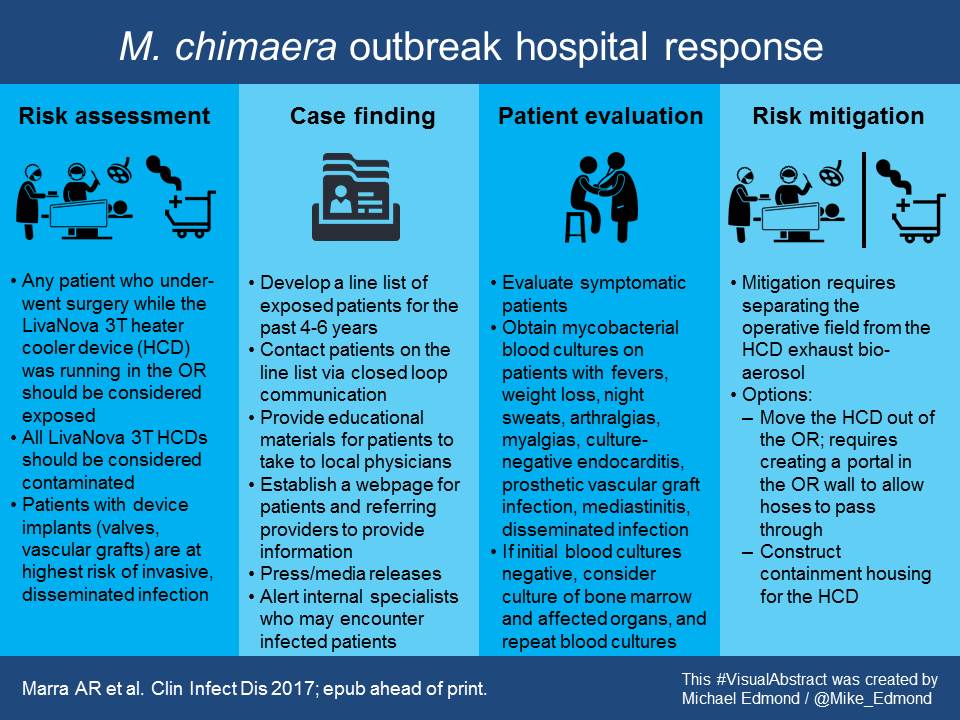
The global M. chimaera outbreak associated with heater cooler devices is still slowly evolving. We continue to learn of new cases through communication with clinicians. Yet the federal health agencies are mostly silent and many (perhaps most) hospitals using the implicated heater cooler devices have not developed a risk mitigation strategy. Thus, this outbreak is likely to stretch over a very long time. We recently published our experience with management of the outbreak in Clinical Infectious Diseases, summarized in the visual abstract below.


Sunday, June 18, 2017
Antibiotics: There's no free lunch
A new, important paper in JAMA Internal Medicine from Sara Cosgrove's group at Johns Hopkins demonstrates the collateral damage of antibiotics. In this retrospective cohort study of 5,579 internal medicine inpatients, 1,488 (27%) received a parenteral or oral antibiotic for at least 24 hours. The most common indication for antibiotics was UTI, Adverse events due to antibiotics were captured over the 30-day period after antibiotic initiation, with the exception of C. difficile infection and MDRO infections, which were captured over the ensuing 90 days. Median duration of therapy was 7 days. Of the patients treated with antibiotics, 19% had no clinical indication for antibiotic therapy, and 20% developed at least one associated adverse event. The breakdown of adverse events is shown in the visual abstract below (note: for this analysis, I combined the 30- and 90-day outcomes). We are becoming more cognizant that antibiotics are not benign therapies. Kudos to Sara and her colleagues for their work in raising our awareness.


Saturday, June 17, 2017
Exposing the myth of "UTI"
Last year, I posted on a commentary by Tom Finucane where he questioned the validity of the concept of "UTI." In a new paper in the Journal of the American Geriatrics Society, he expands on this, adding more evidence to question long-held dogma. I've read this paper three times, and have to admit it leaves you feeling a little like you did when you learned there is no Santa Claus. Most physicians have treated patients for "UTI," and we have long believed in the existence of what we thought is a common pathologic process. Tom Finucane shatters that thinking.
 He lays out a number of important arguments:

- Bacterial colony counts in urine cultures do not predict the need for treatment.
- Urinary tract symptoms do not correlate with significant bacteriuria, pyelo-nephritis, or the risk for secondary bacteremia.
- The presence of pyuria does not predict the need for treatment.
- Acute uncomplicated cystitis is better managed with analgesia than antibiotics.
- Delirium in the elderly does not necessarily warrant urine culture, and treatment of bacteriuria in this setting is not necessarily indicated.
This paper is a must read for anyone interested in antimicrobial stewardship since "UTI" is one of the most common indications for initiating antibiotics in both the inpatient and outpatient settings. Dr. Finucane points out that the term "UTI" itself drives the antibiotic-prescribing reflex. And importantly, he notes that most people treated for "UTI" would probably be better off without treatment. "UTI" is deeply entrenched in our thinking, and although reducing antibiotic treatment of this flimsy construct will be difficult, this paper is a call to action.
Thursday, June 15, 2017
It's my opinion that this treatment won't kill you directly, so....

Iowa recently passed a law that allows physicians to “expand
upon the traditional standards of care for Lyme patients”, provided they get
informed consent from the patient and provided that “in the opinion of the
licensee, [the treatment] will not result in the direct and proximate death of
or serious bodily injury to the patient”. If you don’t believe me, check it out for yourself!
Thanks to the CDC and others (MMWR June 16, 2017) for reminding us that
the opinion of a provider, no matter how well-meaning he or she may be, is no
guarantee that a protracted course of antibiotics or immunotherapy will not, in
fact, lead to “death or serious bodily injury”.
As more states pass laws that protect health care providers
from sanctions (or ensure insurance companies must reimburse) for the use of
unproven and dangerous therapy for “chronic Lyme disease”, this will become an
increasingly important patient safety issue.
Publishing periodic case reports or case series of the unintended but
devastating consequences of these treatments isn’t enough—we should establish a
registry to track these adverse outcomes.
Wednesday, June 14, 2017
Questions for Contact Precautions Eliminators

Question #1: Are hospitals no longer a source for MDRO-bacterial acquisition? Do acute care hospitals or subpopulation (ICUs, hemodialysis) remain sites for patient-to-patient transmission or have we completely eliminated transmission in these settings?
Question #2: If transmission has been eliminated, how would we know? Are you aware of data that proves patients who are uncolonized on admission remain uncolonized by the time of discharge? Does your hospital do discharge surveillance cultures for sentinel organisms like MRSA, CRE?
Question #3: If you don't do surveillance culturing on discharge, do you follow patients post discharge to make sure they don't develop an MDRO infection at a subsequent point? Do patients no longer develop MDRO infections linked to a prior hospital stay suggesting that all transmission is now occurring in the community setting?
Question #4: If transmission in acute-care settings has been eliminated, how has that happened? Is it that hand hygiene compliance of 34 to 57% is enough to halt all transmission? Is it that the environment is so sparkling clean these days that clinicians can't even pick up bad bacteria on their hands?
Question #5: Perhaps you agree that hospitals (or ICUs) are still engines powering the emergence of MDRO in human populations and your hospital might even be a source for patient acquisition. Is it that you think hands are not a source of transmission and contact precautions just don't work? Do you feel similarly about hand hygiene - does hand hygiene not reduce transmission? Since we know that when caring for patients that healthcare workers gloves/gowns become contaminated 8-39% of the time, where do these bacteria go? Do they just disappear?
Question #6: Finally, even if transmission is occurring via the hands of healthcare workers maybe you're convinced it's not your problem? If you can't see the benefits directly in your hospital, it's not important. Tragedy of the commons? - meh. Perhaps, it's up to me to detect all MRSA colonized patients in my clinic or on admission to my hospital and decolonize them?
Wednesday, June 7, 2017
Negative study of the month, C. difficile edition
I like a good negative study, particularly when it’s a multicenter randomized trial about preventing our most problematic healthcare-associated infection. So let’s take a moment to appreciate this work from Amy Ray and colleagues.

These investigators randomized 16 hospitals to either standard cleaning or “enhanced cleaning”, which meant monitoring of environmental services personnel with feedback of performance (measured using fluorescent markers for cleaning and environmental cultures for disinfection). They measured the outcome of healthcare-onset, healthcare-facility associated C. difficile infection (HO-HFCA CDI). The study was powered to have >95% power to detect a 25% reduction in HO-HFCA CDI in intervention hospitals (and 70% power to detect a 15% reduction).
Bottom line: the intervention led to clear improvement in cleaning (better removal of fluorescent markers) and disinfection (reduction in % of C. difficile + environmental cultures in CDI rooms from 13% to 3%--which was the approximate rate of contamination in non-CDI rooms). Unfortunately, there was no reduction in HO-HCFA CDI during the intervention period, and no difference between control and intervention hospitals (see figure below and article for details).

Few people know more about CDI than Curtis Donskey (senior author of this study), so I encourage you to read their interpretation of these negative findings. They cover several potential explanations--the one I find most convincing is that the portion of HO-HCFA CDI attributable to organism acquisition during hospital admission may be smaller than we realize. Thus I agree that we need more studies to help us “identify effective strategies to reduce the incidence of healthcare-associated CDI.”
I’ve already weighed in with my opinion on the most effective strategy.
Anyway, bravo to Ray and colleagues for an excellent addition to our knowledge about CDI prevention!
Thursday, June 1, 2017
Turning up the heat....
Today seems like a good day to highlight the association of climate and infectious diseases—not only vector-borne infections like malaria, Zika, and dengue fever that spread with expansion of the vector’s range, but healthcare-associated infections as well.


Phil Polgreen and colleagues here at Iowa recently published two papers on this topic: one in ICHE, also covered in the NY Times, that found the odds of a surgical site infection (SSI) admission increased about 2% with every 2.8 degree Celsius increase in monthly average temperature (see Figure above for the effect of monthly average temperature on odds of SSI primary admissions). The other, in Open Forum Infectious Diseases, describes a seasonal increase in cellulitis during the summer months. Several prior studies have described seasonality of S. aureus, gram-negative rod, cellulitis and surgical site infections—all with higher rates associated with higher temperature seasons or regions (see full reference list from the OFID paper, which includes prior work from Eli and colleagues on gram-negative rod infections).
Today is also the start of National Accordion Awareness Month, so if you need some cheering up, here’s some awesome accordion work:
Subscribe to:
Posts (Atom)
OSHA! OSHA! OSHA!
In many parts of the country, as rates of COVID-19 are declining and vaccination coverage is increasing (albeit with substantial variati...

-
 Back on clinical service again and having more thoughts on poor hospital design. Last month I wondered why there were no stethoscope wipe...
 -
 Those that follow me on twitter or the blog have probably noticed my recent focus on trying to understand the emergence of compulsory influe...
 -
REUTERS/Athit Perawongmetha With the assistance of a great supply management team, we have been able to outfit all of our clinical staff wit...

