Showing posts with label #VisualAbstract. Show all posts
Showing posts with label #VisualAbstract. Show all posts
Monday, June 19, 2017
Drip, drip, drip...
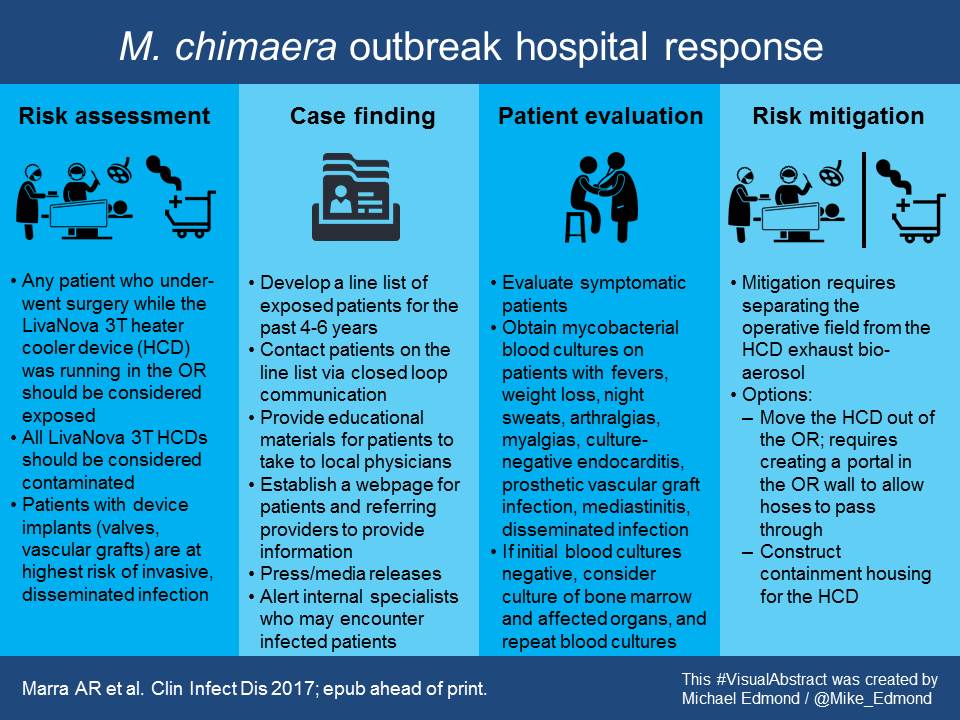
The global M. chimaera outbreak associated with heater cooler devices is still slowly evolving. We continue to learn of new cases through communication with clinicians. Yet the federal health agencies are mostly silent and many (perhaps most) hospitals using the implicated heater cooler devices have not developed a risk mitigation strategy. Thus, this outbreak is likely to stretch over a very long time. We recently published our experience with management of the outbreak in Clinical Infectious Diseases, summarized in the visual abstract below.


Sunday, June 18, 2017
Antibiotics: There's no free lunch
A new, important paper in JAMA Internal Medicine from Sara Cosgrove's group at Johns Hopkins demonstrates the collateral damage of antibiotics. In this retrospective cohort study of 5,579 internal medicine inpatients, 1,488 (27%) received a parenteral or oral antibiotic for at least 24 hours. The most common indication for antibiotics was UTI, Adverse events due to antibiotics were captured over the 30-day period after antibiotic initiation, with the exception of C. difficile infection and MDRO infections, which were captured over the ensuing 90 days. Median duration of therapy was 7 days. Of the patients treated with antibiotics, 19% had no clinical indication for antibiotic therapy, and 20% developed at least one associated adverse event. The breakdown of adverse events is shown in the visual abstract below (note: for this analysis, I combined the 30- and 90-day outcomes). We are becoming more cognizant that antibiotics are not benign therapies. Kudos to Sara and her colleagues for their work in raising our awareness.


Thursday, May 25, 2017
The skullcap feud (Part 2)
Several months ago I posted on the feud between the surgical community and the Association of periOperative Registered Nurses (AORN). This turned out to be a wildly popular post that generated a great deal of discussion on our blog and other websites. You'll recall that AORN outlawed the surgeon's skullcap in its latest guideline on surgical attire. This caused an uproar among surgeons who noted that there was no substantial evidence on which to make this rule.
In a new paper in Neurosurgery, a surgical group at University of Buffalo took matters into their own hands and decided to generate some evidence after their own hospital banned the skullcap and mandated that all OR personnel don bouffant caps. They compared surgical site infection rates for Class I (clean) procedures 13-months before and after the skullcaps were outlawed. During the study period, approximately 16,000 surgical procedures were performed. There was no difference in SSI rates between the two time periods.
So, my hat's off (no pun intended) to the authors. The score now is Surgeons 1, AORN 0. And I suspect that more studies are on the way.

In a new paper in Neurosurgery, a surgical group at University of Buffalo took matters into their own hands and decided to generate some evidence after their own hospital banned the skullcap and mandated that all OR personnel don bouffant caps. They compared surgical site infection rates for Class I (clean) procedures 13-months before and after the skullcaps were outlawed. During the study period, approximately 16,000 surgical procedures were performed. There was no difference in SSI rates between the two time periods.
So, my hat's off (no pun intended) to the authors. The score now is Surgeons 1, AORN 0. And I suspect that more studies are on the way.

Monday, May 22, 2017
Hand hygiene: facilitators and barriers
Although there are many papers on hand hygiene, this new one in American Journal of Infection Control caught my eye. In this study 3,260 hand hygiene opportunities among 64 ICU nurses in 4 hospitals were overtly observed. When HH noncompliance was observed, the reason was documented. Nearly 20% of missed opportunities were accounted for by 4 activities: carrying something, even as small as a syringe or 4x4 (9%), donning gloves or PPE (6%), pushing or pulling a work station (2%), and using a mobile device (1%).
The investigator observed that nurses who were super compliant (90-100% compliant) found ways to deal with the barriers. For example, if they were carrying something, they shifted the object to one hand and reached for gel with the other. They were positive deviants.
The high performers were asked to explain why their compliance was high and four themes emerged: (1) they had internalized standard precautions; (2) they had experienced a previous exposure and were determined to not allow it to occur again; (3) bonuses and pay raises were linked to compliance; and (4) pregnancy and concern for their unborn child.
A better understanding of the barriers and facilitators may allow us to move the needle a bit on one of the most perplexing problems in infection prevention.

The investigator observed that nurses who were super compliant (90-100% compliant) found ways to deal with the barriers. For example, if they were carrying something, they shifted the object to one hand and reached for gel with the other. They were positive deviants.
The high performers were asked to explain why their compliance was high and four themes emerged: (1) they had internalized standard precautions; (2) they had experienced a previous exposure and were determined to not allow it to occur again; (3) bonuses and pay raises were linked to compliance; and (4) pregnancy and concern for their unborn child.
A better understanding of the barriers and facilitators may allow us to move the needle a bit on one of the most perplexing problems in infection prevention.

Sunday, May 21, 2017
Working while sick
A few days ago, I learned about visual abstracts, a great way to encapsulate the essence of a paper. You can read more about visual abstracts here. Here's my first attempt using a recent paper in the American Journal of Infection Control.

This paper tells us that hospitals can't just mandate influenza vaccine for their workers and think that they have done their job. Preventing the transmission of respiratory illnesses requires a more comprehensive approach that makes a real attempt at keeping sick healthcare workers at home. Of note, the rate of vaccination in the survey participants was 45%, and vaccine effectiveness that season was only 19%.
Bottom line: Influenza like illness (ILI) has many causes, influenza vaccine is modestly to moderately effective against three of those, and healthcare workers continue to place patients at risk by coming to work when sick with ILI.

This paper tells us that hospitals can't just mandate influenza vaccine for their workers and think that they have done their job. Preventing the transmission of respiratory illnesses requires a more comprehensive approach that makes a real attempt at keeping sick healthcare workers at home. Of note, the rate of vaccination in the survey participants was 45%, and vaccine effectiveness that season was only 19%.
Bottom line: Influenza like illness (ILI) has many causes, influenza vaccine is modestly to moderately effective against three of those, and healthcare workers continue to place patients at risk by coming to work when sick with ILI.
Subscribe to:
Posts (Atom)
OSHA! OSHA! OSHA!
In many parts of the country, as rates of COVID-19 are declining and vaccination coverage is increasing (albeit with substantial variati...

-
 Back on clinical service again and having more thoughts on poor hospital design. Last month I wondered why there were no stethoscope wipe...
 -
This is a guest post by Jorge Salinas, MD, Hospital Epidemiologist at the University of Iowa Hospitals & Clinics. There is virtually no...
-
I’m surprised that we can’t stop arguing about the modes of SARS-CoV-2 transmission, despite the fact that most experts (including our frie...

