Thursday, December 29, 2011

What do sinks & contact lenses have in common?


Every infectious diseases doctor hates Fusarium, as therapeutic options are limited and relatively ineffective. I suspect the ophthalmologists do too, since Fusarium can cause severe keratitis in contact lens wearers.

This month's issue of Journal of Clinical Microbiology has an interesting study, funded in part by Bausch and Lomb (the maker of a particular contact lens cleaning solution that appeared to be associated with cases of Fusarium keratitis), on detecting the environmental source of the organism. Like many of the pathogens that infect profoundly immunosuppressed patients, Fusarium is also found in the environment, but unlike many other opportunistic fungal pathogens, it doesn't enter the body via the respiratory tract.

Investigators in this study sampled nearly 500 drains, primarily of bathroom sinks in 7 eastern states as far north as Pennsylvania, as far south as Florida, as well as California. They found that 66% of sink drains harbored Fusarium. Moreover, the most common strains detected are the most common strains that cause clinical infections. Importantly, this organism produces and lives in biofilm, which not only coats your sink drain, but can coat your contact lenses when they are inappropriately cleaned.

Photo: Fusarium macroconidia

Tuesday, December 27, 2011

Two papers linking XMRV and chronic fatigue syndrome retracted

Mike posted on a paper refuting the possible link between XMRV and chronic fatigue syndrome over a year ago.  Now it appears that both the 2009 Science paper and  2010 PNAS paper supporting such a link have been retracted.  The reasons for retraction of each paper appear to be very different.  For example, the story of the Science paper authors' possible image manipulation described by blogger Abbie Smith is pretty fascinating.  A great description of both retractions and related media reports can be found for both the Science and PNAS paper at Retraction Watch.  All of this is very unfortunate for the scientific community and especially the affected patients.

Sources:

Retraction of Lombardi et al., Science 326 (5952) 585-589 in Science 23 December 2011: Vol. 334 no. 6063 p. 1636 

NY Times, David Tuller 12/26/2011

h/t Ivan Oransky at Retraction Watch Blog 12/26/2011

Wednesday, December 21, 2011

Scientific inquiry, biosafety, and censorship

Investigators at the University of Wisconsin and at Erasmus University in the Netherlands have modified the H5N1 avian influenza strain so that it is not only highly virulent but also can be efficiently transmitted (at least among ferrets). Since the release of such a strain (high lethality, high transmissibility) would set the stage for a real-life version of the movie Contagion, there has been some high level angst about the wisdom of publishing the details of these experiments. This is kind of a big deal now, with a U.S. government panel appealing to two high-profile scientific journals (Nature and Science) to keep the experimental details out of the published reports of these experiments.

It appears that the scientists and institutions involved will comply with the recommendations of the National Science Advisory Board for Biosecurity. However, this work has already been presented at open scientific meetings, and detailed articles have been sent for peer review. And as Ron Fouchier, the lead investigator at Erasmus, says in today’s NY Times, “as soon as you share information with more than 10 people, the information will be on the street.” Finally, one purpose of the work was to identify those mutations that lead to greater transmissibility, so that they can be quickly detected during surveillance to help guide prevention efforts. I don’t think this can be done while simultaneously keeping those mutations a secret.

Monday, December 19, 2011

Contact precautions, and why I hate them, holiday edition

Investigators at the University of Maryland (and one or two who used to be there) are among few who are carefully examining the unintentional adverse consequences of contact precautions. Their latest publication comes out in January’s ICHE. In this paper, they report an association between starting contact precautions during hospitalization and delirium.

After adjusting for comorbid conditions, age, sex, ICU status, and length of stay, Day and colleagues found that patients newly placed under contact precautions during hospitalization were more likely to experience delirium (odds ratio 1.75, 95% CI 1.6-1.9). Delirium was defined by ICD-9 code, supplemented by use of restraints and anti-psychotic meds (this measure was validated by randomly-selected chart review). Curiously, this association did not hold for patients admitted to the hospital under contact precautions. As the authors point out, those admitted under contact precautions weren’t nearly as sick as those newly placed under precautions during hospitalization, which may account for this difference.

I’ll be the first to point out that this study doesn’t prove causation—however, the study does support our previous recommendations that patients placed under contact precautions should be carefully monitored for adverse psychiatric consequences.

Friday, December 16, 2011

Congratulations, Mike!

On being selected by HealthLeaders magazine as one of their 2011 “HealthLeaders 20”, twenty individuals they consider to be “changing healthcare for the better”. Mike’s profile can be found here. And yes, I found a photo of him wearing a tie.

No White Coats in Miami!!

I know it never gets cold in Miami, so they have one less excuse to hear from clinicians, but we wanted to share with you a new practice at Jackson Memorial Hospital in Miami, Florida.  Silvia Munoz-Price, Medical Director for Infection Control, shared that this past month they have found that white coats and scrubs were contaminated with the same pathogens as found on the hands of providers wearing the coats/scrubs. Thus, for the past 2 weeks they have been doing ID rounds wearing scrubs or bare below the elbow and without white coats. They report receiving "no negative feedback from the staff nor patients." Way to go Team Miami!

Thursday, December 15, 2011

Failure of Freakonomics

Andrew Gelman (Columbia) and Kaiser Fung (NYU) have an interesting article in the Jan/Feb 2012 issue of American Scientist that is worth a read. They review the popular Freakonomics franchise of Steven Levitt and Stephen Dubner. Freakonomics and SuperFreakonomics have set the standard for the popular statistics/economics genre, from which Gelman and Fung have both benefited. (click on their names to see their books)

However, Gelman and Fung have identified a "tendency in the Freakonomics body of work to present speculative or even erroneous claims with an air of certainty."  Overall, I'm not so worried about the small errors they outline, but the reasons for the errors are concerning and the solutions are important ones to consider in any scientific discipline, including healthcare epidemiology.

One major problem they identify is Levitt and Dubner's reliance on linear informal social networks. For example, in the original Freakonomics, the network was "Levitt did the research, Dubner trusted Levitt, the Times trusted Dubner." However, as time pressures built and the need for more unique stories increased in SuperFreakonomics the network devolved into "Levitt trusts brilliant stars such as Myhrvold or Oster, Dubner trusts Levitt, and we the readers trust the Freakonomics brand."

The solution offered was that they should "leave friendship at the door."  I think this is something all scientific disciplines could benefit from.  It is clear that editorial boards, grant review committees and annual meeting planning committees are all at risk from reliance on a "linear" closed social network (in the past called "old boys' network"). They suggest that building more "non-linearity" into their research and evaluation would protect the process from what I might call a "friendship" bias.  Excellent advice, perhaps difficult to put into practice, but worth the effort.

link: American Scientist Jan/Feb 2012

The iPatient and patient safety

Last December Mike published a piece in the Annals of Internal Medicine about how care delivery has changed on medical teaching services, including the reduction in physician interaction that now occurs as a result of residency hour limits and of the computerization of health care delivery. Residents and fellows now spend hours per day sitting in front of computer terminals, from which they must complete nearly every task (except, you know, actually seeing a patient, when telemedicine is not an option).

The NY Times has an article today on another unintended consequence of our increased reliance on computers and handheld devices—distracted doctoring. Distractions come not just from our obsession with what Abe Verghese calls the “iPatient” (that wealth of digital data each patient accumulates during even a short hospital stay), but also when we use devices for non-patient related activities during rounds, in the operating room, etc. Read the piece for yourself, and decide if this anecdotal problem is a real issue for patient safety (and if so, how to measure it, and how to implement change, when computers have become so essential for patient care). My favorite quote in the piece:

“The iPatient is getting wonderful care across America,” Dr. Verghese said. “The real patient wonders, ‘Where is everybody?’ ”

Wednesday, December 14, 2011

Tuesday, December 13, 2011

Patient Zero - Typhoid Mary through HIV

WNYC's Radiolab typically covers scientific and philosophical topics.  I just listened to their recent show/podcast titled "Patient Zero", which was fantastic. They start off discussing Typhoid Mary - the iconic Patient Zero. They tell 'the rest of the story', which I would guess that most of us haven't heard before. They then trace the molecular epidemiology of HIV back to a mystic first transmission to humans in Africa. They finish up with a discussion of the first ever High Five. It seems that high fives are even more infectious than infectious diseases. High fives all around.

Source: November 14, 2011 Radiolab podcast: "Patient Zero"

Monday, December 12, 2011

IDWeek Rejected Session

Dan and I are in DC today for the IDWeek Program Planning Committee meeting. Of course, we can't discuss actual sessions, so I thought of a fake session to get you excited for the 2012 joint meeting.

Session Title: Infectious Disease Issues on Sesame Street

Stop Blaming the Birds: From West Nile to Avian Flu - speaker: Big Bird

Risk factors for "Red Man Syndrome" - speaker: Elmo

Salmonella Typhimurium and Water Frogs - speaker: Kermit the Frog

Y. pestis or Francisella tularensis in Prairie Dogs - speaker: Prairie Dawn

Saturday, December 10, 2011

S. aureus decolonization: Review of the benefits

In the December 2011 Lancet ID, Andrew Simor from the University of Toronto reviewed articles listed in PubMed from 1989-2010 assessing the benefits of S. aureus decolonization. There were no surprising results. In fact, most of the conclusions were hedged.  For example he says that "some data support the use of decolonisation in surgical patients colonised with S aureus, particularly in those undergoing cardiothoracic procedures" and  "patients undergoing chronic haemodialysis or peritoneal dialysis might benefit from decolonisation, although repeated courses of treatment are needed, and the effects are modest." The hedging is not a criticism of the author, but rather due to the lack of funding for proper infection prevention studies.  What is surprising is that this is a single-author paper.  Any systematic review should be completed by more than one author, in my opinion. Another limitation is the lack of summary odds ratios. However, this is a very good literature review and a wonderful resource.

Source:  Simor AE, Lancet ID December 2011

Some norovirus with your entree?

We've blogged before about the problem of presenteeism in healthcare workers. We've all seen coworkers come to work sick and maybe have even done that ourselves. But from a public health perspective, presenteeism isn't just a problem for doctors and nurses. Those who work in the food service industry can spread gastrointestinal and other infections when they come to work sick. And they are very likely to work while sick. An article in the latest issue of The Progressive points out that 80% of food servers in the US lack paid sick leave. The Restaurant Opportunities Center United (ROC) in a survey (below) of 4,300 food service workers found that nearly 2/3 of these workers prepared or served food while sick.


ROC has also published a diners' guide (full text here), which includes information on which restaurants do and do not provide paid sick leave for their employees.

Friday, December 9, 2011

More on fecal transplants

Maryn McKenna has two new pieces on fecal transplants on her blog and in the latest issue of Scientific American (full text here). These are very well written. I plan to use these for patient education when I see patients with recurrent Clostridium difficile infection for whom fecal transplantation may be an option.

Addendum (2/1/12):  Click here to listen to an interview with Maryn McKenna on the topic of fecal transplants.

Thursday, December 8, 2011

Best news ever! A Norovirus vaccine that works!

As a parent or two young kids, I dread the slightest hint of nausea. Now, perhaps, I might have one less pathogen to fear and perhaps in old age, I can even take a cruise.

In the recent NEJM there is a report of an RCT assessing the safety, immunogenicity, and efficacy of an intranasal norovirus viruslike particle (VLP) vaccine. The study was conducted in adults aged 18 to 50. They received two doses of either vaccine or placebo and were subsequently inoculated with Norwalk virus during an inpatient challenge with 10 times the infectious dose and monitored for infection and gastroenteritis symptoms for a minimum of 4 days. (No way I'd ever volunteer for this study)

The study included 98 patients with 90 completing both injections. A Norwalk virus–specific IgA seroresponse was found in 70% of vaccine recipients. This level of response is  similar to my old Maryland colleague Samer El Kamary's 2010 JID paper that showed a 79% response rate. Vaccination significantly reduced the frequencies of Norwalk virus gastroenteritis (occurring in 69% of placebo and 37% of vaccine recipients, P=0.006) and Norwalk virus infection (82% of placebo and 61% of vaccine recipients, P=0.05). Not perfect, but still a great result.

Note: These data were also presented at earlier IDSA (2010) and ICAAC (2011) meetings.

Source: RL Atmar et al. NEJM Dec 8, 2011

Update: This news is pretty good too. (Massive drop in in-hospital deaths...in Canada)

Wednesday, December 7, 2011

Deus ex machina (Part 4): Flavonoid-like Molecules

Flavo-Noid?
When I started the Deus ex machina "meme" three weeks ago, I had no idea that so many potential novel antimicrobials would just suddenly appear.  First we had tiny magnets, then we had DNA or RNA gold nanoparticles and now word comes that there is a newly synthesized family of flavonoid-like molecules with antibacterial and antifungal activity.

Fowler et al. in PLoS ONE examined flavonoids, which are abundant plant metabolites with anti-infective activity. They used a natural flavonoid scaffold to create novel flavanones and tested their efficacy versus E coli, B subtilis, Cryptococcus neoformans and Aspergillus fumigatus. They screened eight molecules and found that 4-chloro-flavanone was the most potent antimicrobial compound.  What did Ralph Waldo Emerson say? I think it's that "We judge of man's wisdom by his hope."  Keep hope alive.

Source: Fowler et al. PLoS ONE 2011

Via:  Hampton T, JAMA 2011

Monday, December 5, 2011

Close the lid before you flush?

Photo:  Eljer Toilet Seats
A new study in the Journal of Hospital Infection evaluates what happens when a toilet that contains Clostridium difficile is flushed. Using air sampling and settle plates placed around the toilet, the investigators determined that the organism is aerosolized by the flush and could be found on most of the settle plates. Interestingly, if the toilet lid were closed prior to flushing, C. difficile could not be recovered from any of the settle plates. Unfortunately, hospital toilets typically don't have lids, and the investigators recommend that hospital toilets should be fitted with lids. However, this would mean that the undersurface of the lids would quickly become contaminated, which could also cause problems.

There's an old pearl bantered about by infectious diseases doctors that the world is covered with a thin veneer of stool. This study and the one I blogged about a few weeks ago surely provide proof of that.

Saturday, December 3, 2011

Deus ex machina (Part 3): DNA Gold Nanoparticles

Dr. Chad Mirkin
Yesterday, NPR's Science Friday had a discussion of a novel antimicrobial based a platform of spherical nucleic acids that have been developed at Northwestern. Dr. Chad Mirkin, director of the International Institute for Nanotechnology at Northwestern University, discussed the possibility that DNA or RNA gold nanoparticles could be designed to invade bacterial cells and "either turn off resistance so that a conventional antibiotic will work or, better yet, stop replication and ultimately cause bacterial cell death." Sounds pretty exciting and human trials are expected soon.

The most important thing mentioned was that DARPA, the research arm of the Defense Department, has called for development of new, next-generation antibiotics.  You can see by the host Ira Flatow's comments (quotes below) that he is perplexed as to why the Defense Department is leading the charge.

FLATOW: "And why is it that DARPA has to jump in here? What's wrong with our own medical system?"

FLATOW: "So what you're saying is that the people are willing to spend money on the military to do this where they might not in the civilian case."

Transcript: Hitting The 'Off' Switch On Antibiotic Resistance

Listen to the program (NPR 12/2/2011)

Friday, December 2, 2011

Ethical Issues in Cluster-randomized Trials

*Ottawa is in Canada
Infection prevention studies, particular ones that aim to prevent transmission of resistant pathogens (or influenza) are typically carried out at the population (e.g. ICU) level.  Thus, the study design of choice is the cluster-randomized trial.  The Ottawa Hospital Research Institute has recently held a conference and developed a set of documents highlighting the key ethical issues in these trials.

These papers cover topics such as: (1) Who is the research subject in cluster randomized trials in health research? (2) When, and from whom, is informed consent required in cluster randomized trials? (3) Does clinical equipoise apply to cluster randomized trials in health research? (4) Assessing benefits and harms in cluster randomized trials and (5) Cluster randomized trials in vulnerable populations.  These papers have or will soon be published in the open-source journal Trials.


Source: OHRI CRT Ethics page

Wednesday, November 30, 2011

Breaking...bacteria are everywhere!

As we recently found with our hospital curtain study, the media are fascinated with the fact that bacteria can survive on inanimate objects. The latest culprit, as outlined in this LA Times article, is paper. Paperless electronic medical records would seem a great solution to this problem, were it not for those germ-laden computer keyboards!

The solution is simple, fortunately. Just make sure that the last thing you touch prior to contact with a patient is an alcohol hand sanitizer.


Monday, November 28, 2011

Deus ex machina: duabus partibus (Part Two) - Tiny Magnets

With infectious diseases, there is always another miracle around the corner.  The problem is that the miracle typically stays around the corner. Come on down...The next contestants in the search for a miracle cure are..."tiny magnets."

Researchers in Switzerland are developing nanomagnets that could remove harmful compounds (e.g. bacteria) from the blood. The technology involves magnetized nanoparticles coated with carbon and pathogen-directed antibodies. The plan is that the antibodies attach to the pathogens and then the whole compound is removed from the blood with hemodialysis. Sounds pretty exciting. Probably exciting enough to hold off on further investments in infection prevention research, not!

Source: Technology Review (MIT): 11/28/2011

Friday, November 25, 2011

Taking hand hygiene monitoring to a new level

Photo: Richard Lee, New York Times
CS = current shift; WR = weekly rate
A new study in Clinical Infectious Diseases details the use of video monitoring in North Shore University Hospital's medical ICU to improve hand hygiene compliance. Video cameras were placed in hallways and every patient room with remote video monitoring performed by observers in India.

In the initial phase of the study (16 weeks), no feedback was given to healthcare workers in order to determine the baseline rate of HH compliance, which was found to be incredibly low at 6.5%. In the second phase of the study (16 weeks), realtime feedback was provided by electronic boards (shown in the photo), with more detailed reports emailed to unit leadership 3 hours after start of each 12-hour shift and at the end of shift, as well as a weekly summary. During this period, hand hygiene improved to 82%. The third phase of the study (75 weeks, interventions identical to the second phase) showed the overall compliance rate to be 88%.

So here we have a very interesting study with compelling results. Unfortunately, the authors do not provide any data on infection rates. Given that we believe that hand hygiene and infection rates are linked, if any group were ever in a position to prove this dogma, it is these investigators with data on 400,000 hand hygiene opportunities over a 2 year period.

Some additional information on the study can be found in the Fixes blog at the New York Times web site. In that piece the cost of the surveillance system is delineated--$50,000 for the video equipment with $1,000 per month for "maintenance." We are not told if "maintenance" is the cost of the wages for the persons doing surveillance, who are employed by a company in the business of remote video auditing.

The authors point out that the healthcare workers were all informed that hand hygiene would be monitored, and all feedback was done at the aggregate level without identification of individual healthcare workers during the study. But I'm left with an uneasy feeling. It seems somewhat absurd to me to devote this level of resources to a single element, albeit an important one, of patient care. Even more absurd is that the real work is being done in a third-world country (whose public health infrastructure is so primitive that half of the population is forced to defecate in the open) by human observers making very low wages in order to make marginal improvements in the quality of care in an ICU setting (where a great deal of futile but incredibly expensive care is delivered) in the richest country of the world. I just can't wrap my arms around that juxtaposition.


Thursday, November 24, 2011

I'm thankful for the CDC

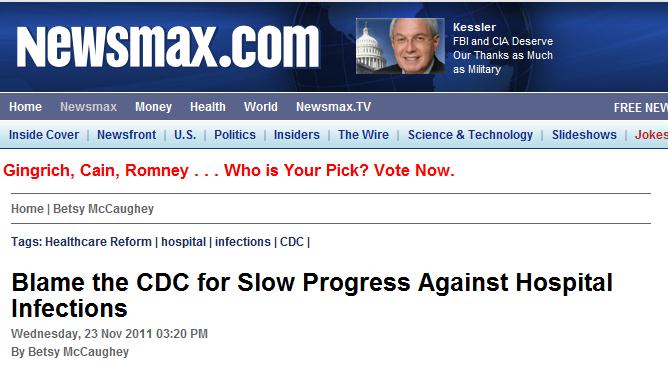
Last night, I stumbled across a link to this piece:


Somehow I read all the way through it before I saw who had written it. Then it all made sense. Like a bad penny, Betsy McCaughey, turns up yet again. Since it's a holiday and I would prefer to stay in a joyful mood, I won't write anything about her, but refer you here to see our previous postings about her.

So on this Thanksgiving Day, I'm thankful for the CDC. Over the course of my career, I have come to know many people who work there, particularly in the hospital infections group. They are simply a great bunch--smart, hard-working, dedicated people who do great work with little recognition. The CDC has been working in the area of healthcare associated infections for over four decades and it's difficult to imagine what healthcare epidemiology would look like today were it not for these folks.


Wednesday, November 23, 2011

In case you need another reminder to wash your hands...

Photo: Medical Tips Blog
There's a new paper in PLoS One on the biogeography of public restrooms (full text here). In other words, some investigators cultured various surfaces in 12 bathrooms on a university campus and then mapped out areas where groups of bacteria (e.g., skin flora, gut flora, genitourinary tract flora, and soil organisms) were found. The results were quite predictable. Soil organisms were dominant on floor surfaces (brought in via shoes), skin organisms dominated on faucets, and fecal organisms dominated on toilet surfaces. Of note, toilet flush handles were found to harbor both fecal organisms and soil organisms, and the authors postulate that the soil organsims are deposited there when people flush toilets with their feet in order to avoid touching the flush handle with their hands.

Ironically, one of the sponsors of the study was the Howard Hughes Medical Institute, the foundation started by an infamous germophobe.

So for all of you using the bathroom in an airport, train or bus station on this Thanksgiving eve:  Wash your hands! And turn off the faucet with a paper towel.

Paul Offit and the Dangers of the Anti-vaccine Movement


Paul A. Offit, MD, talks with Eli Y. Adashi MD, Brown University and Medscape, about the history and hazards of the anti-vaccine movement. "Residual damage, 40% of parents are now delaying or withholding one or more vaccines from the children." You can read our prior posts on Dr. Offit here.

Collateral damage: The ongoing measles epidemic in Quebec.

Tuesday, November 22, 2011

Novel H3N2 Influenza in Iowa: More bad news from pig country

PIGS: Portugal, Italy, Greece and Spain
When it rains, it pours.  Dr. Patricia Quinlisk, medical director for the Iowa Department of Public Health, announced today that a novel H3N2 influenza A strain had infected three Iowa children.  Evidence points to one child transmitting the virus to the other two. There have been seven prior cases of this strain, all in the US (Maine, Indiana and Pennsylvania) and all apparently linked to animal exposure, which makes the Iowa cases unique. All but one case has been in children under 10 years old, suggesting prior year exposure to H3N2 might be protective. Perhaps it's ironic that this novel swine strain was first transmitted from human-to-human right here in pig country.

Sources: Des Moines Register 11/22/2011 and Winnipeg Free Press 11/22/2011

Addendum: Iowa just added 2,300 jobs, which I think is about double our human population.  I think two job seekers family members (update:  actually just in for Thanksgiving) from other states even moved in with Dan this past weekend.  Getting crowded here, which might be increasing the flu transmission.

Actual update on the virus: "In these ten most recently reported cases, the virus has been a swine H3N2 virus with the M segment gene borrowed from the 2009 H1N1 virus. Essentially a hybrid – a new reassortant virus - that until this summer had not been seen before." source: Avian Flu Diary

More bad news from pig country

It is kinda funny moving back to the Midwest after spending almost 20 years on the east coast. To be specific, I grew up in the East North Central region (Great Lakes States) and now find myself in the West North Central (Great Plains States); never mind that Iowa isn't actually in the Great Plains.  People are always asking why I would move back or what's it like there in flyover country or the heartland or Middle America - I just smile and say that "all the women are strong, all the men are good looking and all the children are above average." Most of the over-stressed, over-crowded coastal folk have at least heard of Garrison Keillor, so that usually changes the conversation...

The Atlanta Braves' new mascot?
OK, so Maryn McKenna has a nice post over on her Wired Superbug blog discussing two studies looking at MRSA in US retail meats. She first reviews a study by Blake Hanson in Tara Smith's U. Iowa lab that found MRSA in retail pork including spa type t034 (ST398). 

The second paper from University of Maryland College Park included testing of 694 samples of retail ground beef, ground pork and ground turkey in the DC area. The somewhat surprising finding was the 17% of turkey and 17% of pork samples were contaminated with MRSA.

The funny part of McKenna's post was that she said that Tara Smith's work was particularly important because "they probably know ST398 better than any other US team looking at the strain" (OK, that's good) "and unlike the other research groups, they are embedded in pig country." ???

We can all agree that Iowa produces a lot of pork, but what about Virginia which is #4 or #5 in turkey production.  I guess, we can refer to people in Alexandria as being from turkey country. Oh, and Georgia is #1 in broiler production, so people from Atlanta are now from chicken country.  I guess, this re-transplanted Midwesterner is becoming overly sensitive...

Addendum: Strictly speaking, PIGS countries are Portugal, Italy, Greece and Spain which are in the midst of an economic crisis. Iowa's unemployment rate sits at 6% and is operating in a close to balanced budget.

Sunday, November 20, 2011

Dogs on call


Many hospitals have pet therapy programs. At VCU, the Dogs on Call Program is a part of the Center for Human-Animal Interaction, which conducts research on the therapeutic effects of interacting with animals. Click here to view a video about the program.

Now I'm sure that these programs make some of us in Infection Prevention nervous. But as I have argued many times before, an infection-free hospital stay may not be the be-all and end-all for every patient. Sometimes infection prevention is trumped by other facets of patient care. And this, I think, is one of them.
 

Friday, November 18, 2011

Weekend Update: Almost Thanksgiving Edition

Batterio killer al II Policlinico: due bambini fuori pericolo
Il Secondo Policlinico: Source NapoliToday


Leggi tutto: http://www.napolitoday.it/cronaca/batterio-II-policlinico-neonati-fuori-pericolo.html
Diventa fan: http://www.facebook.com/NapoliToday
Just some random stuff for your enjoyment while you're running around trying to get everything ready before you (a) are invaded by family/friends or (b) invade family/friends or (c) both.

#1: Recently, there was a serious outbreak of Acinetobacter infections in the neonatal care unit of Batterio killer al II Policlinico: due bambini fuori pericolo
Secondo Policlinico di Napoli, which resulted in the closure of the unit/department/hospital depending on the report you read. English or Italiano

h/t Maryn McKenna

#2: November 14-20, 2011 is Get Smart About Antibiotics Week. SHEA, APIC and IDSA all support this effort and so do we. See also the CDC Get Smart website.

#3: CDDEP has a new ResistanceMap showing US antibiotic prescriptions per capita at the state level. Each state's use is listed.  The worst offender: West Virginia which uses approximately 1.2 antibiotic prescriptions/person. Alaska has the lowest use with about 0.5 prescriptions/person. Where does your state rank? Check out CDDEPs map!

#4: Scientific America has an interesting post by Katherine Harmon reviewing two recent Science papers.  There is new evidence as to how S. aureus, E. coli and P. aeruginosa respond to stress and how this new knowledge might be exploited to enhance existing antibiotics. Shatalin et al. Science 18 November 2011: Vol. 334 no. 6058 pp. 986-990 and Nguyen et al. Science pp. 982-986


Thursday, November 17, 2011

Deus ex machina and antibiotic resistance

Last night, I watched a movie with my young kids. The "plot" involved friends traveling with one of their moms to Japan and then getting lost.  It was a bit scary for my kids. I was even a bit worried, since I had no idea how they would ever be found, but this was a Disney movie, so I knew it had to have a happy ending. Just when it all looked lost, the mom realized she had placed a tracking device under her son's skin when he was a baby and she also happened to have the required GPS tracking device in her purse.  Boom! Kids found, all was well. Ridiculous. Sure, my kids were happy, but where is the lesson there?

Flashback to a conversation I had three weeks ago with a visiting professor in general internal medicine.  She is a very well-known clinical researcher in oncology, an area that is well-funded unlike antibacterial resistance, and I wondered what she thought of the lack of new antibiotics in the pipeline, the rise of novel resistance mechanisms in Gram-negatives like NDM-1 and how she thought this would impact oncology.  Her response? Her jaw dropped.  She thought that there was always another antibiotic in the pipeline or in the ID physicians back pocket to pull out and save her patients. It had actually never occurred to her that we have had close to zero new classes of antibiotic in decades.  It was like life was a Disney movie and we could just pull a new antibiotic out of the air to save the day. Ridiculous.

But, whose fault is that?  I don't think it is the oncologist's fault. Is it the ID physician's fault who always sounds so smart and attempts to prove her usefulness by pretending that a polymixin is a useful new antibiotic! Is it the funding agencies that have ignored bacterial infections since the 1960's and certainly since the 1980's?  Is it the pharmaceutical companies that closed most antibacterial drug discovery units or governmental rules (patents) that bias against antibacterial investments?  Of course, the answer is all of the above and more.  All I can offer is that we have to stop pretending that some magical antibiotic will be discovered. There will be no 10x20 to rescue our patients.  I would settle for 2x20 or how about "1 good one by 20".

As ID physicians, I think we need to stop pretending that we have effective antibiotics. We need to be more honest about the hopelessness of the situation. If a well-trained practicing oncologist isn't aware of the problem, we aren't doing our job. When we face facts, we will have a better chance of convincing the public and government to actually invest in infection prevention and antibacterial drug discovery. This isn't some Disney movie.

Tuesday, November 15, 2011

The user experience

I was going to start this post by explaining how busy I’ve been, why I haven’t posted in a while, blah, blah, blah. Then I realized I would undercut that immediately by revealing that I’ve just finished reading Walter Isaacson’s biography of Steve Jobs. I read it on an iPad, of course, so didn’t realize it was over 600 pages long until I had finished it and saw it on display at a Detroit airport bookstore yesterday.


I highly recommend it. I enjoyed learning more of the story behind the personal computer revolution that still seems so recent to me (I vividly recall using the Commodore 64, and then the Mac, both of which were released while I was in college). But I mostly marveled at the fierce vision (and meanness) of Jobs, and how he was still able to motivate people and channel this vision into so many great products.


Does it contain any lessons for healthcare epidemiologists and infection preventionists? I hesitate now, because I hate facile comparisons of other industries with healthcare delivery (yes, I understand that we can learn lessons from the airline industry or FedEx, but I’ll be more receptive when FedEx starts delivery packages that arrive at their drop-boxes with multiple co-morbidities, or when Delta can fly me from Boston to Moline without a missed connection due to multiple small system failures—explaining why I was browsing Detroit airport bookstores yesterday afternoon). I was taken, though, with Jobs's laser-like focus on “end-to-end integration”, and maintaining control of the entire user experience (hardware, software, and content):

“His quest for perfection led to his compulsion for Apple to have end-to-end control of every product that it made…This ability to integrate hardware and software and content into one unified system enabled him to impose simplicity”

Simplicity means that users can actually enjoy, and benefit from, the products in an easy and intuitive way. While digital enthusiasts and computer geeks might want malleable open systems, most of us just want to be able to download that cool song we heard yesterday onto our music player without using too much profanity in front of our kids.


Meanwhile, the U.S. healthcare system might be the least integrated “system” in the world. Hence the “user experience”, to borrow one of Steve Jobs's favorite phrases, “truly sucks.” Having just navigated an elderly family member’s transition through acute care, assisted living, skilled care, and home again, I can honestly say that having some inside knowledge of the system doesn’t help much—it still sucks. Many patient safety initiatives, including infection prevention initiatives, are akin to software patches, temporary fixes to problems that wouldn’t exist if we had a truly integrated system—integrated not around RVUs, profits or operating margins, but around the patients’ simple goal: to get better, and not to be harmed in the process.

Wednesday, November 9, 2011

I'm having a (hand-hygiene) moment

We have been working on a hand hygiene surveillance project here in Iowa City. One of my collaborators, Heather Reisinger, just went through and listed all possible "moments" for hand hygiene listed in the various guidelines, which I've pasted below.  Yes, I know there is overlap.

However, I think this list exemplifies why we fail in our infection prevention efforts. How can we take such a simple thing as hand-hygiene and make it this complicated? How can the WHO Guidelines on Hand Hygiene be 270 pages long?!?!?! How can we have directive after directive and keep making it more complicated?

Solution: the Iowa City ONE Moment For Hand Hygiene: After you touch anything

And no, you don't need the before since if you haven't touched anything after you practiced hand hygiene, then there hasn't been a moment for hand hygiene.  It is only AFTER you touch something/anything! that you have to practice hand hygiene.

Take off gloves - you touched them, wash your hands! 

Did you touch a patient, then use hand rub and then exit the room? Do you need to practice hand hygiene? NO; but did you touch anything on your way out, such as a door handle? If yes - practice hand hygiene! 

EOR

16 Moments For Hand Hygiene

___entering patient room
___before touching a patient
___before handling medication
___before clean/antiseptic procedure
___before putting on sterile gloves
___after removing gloves
___after exposure to body fluid
___after visibly dirty/soiled
___moving from a contaminated body site to another body site during the care of the same patient (say that one three times while rubbing your belly and head)
___after touching equipment or patient surroundings
___after touching a patient
___exiting a patient room
___before eating
___after using the restroom
___when preparing food
___after delivering food (if worker touches patient, bed linens, or objects in the room)

20 years ago, Magic Johnson changed the AIDS epidemic


Twenty years ago, Magic Johnson announced his retirement from the NBA because of HIV infection.  I remember that moment well. I was in medical school and we all knew that HIV could infect all people.  However, at the time little national attention was given to the broad risks of the disease, since the general public and politicians thought that only homosexuals, Haitians, hemophiliacs and heroin addicts (the 4 H's) could contract the virus.

Magic's honesty and subsequent appointment to the National Commission on AIDS changed the whole discourse. Magic didn't have to do what he did.  He didn't have to go public. He could have retired and probably lived his life. He took a risk and it paid off for all those with HIV and AIDS. Back then, we all thought this was a death sentence for Magic, like it was for so many before him. Magic's role in changing the conversation probably saved his life and certainly saved many other lives. Thanks Magic.

Personal note:  My med-school friend's (Laura Jana) mother, Dr. June Osborn, was the chair of the National Commission on AIDS and played a significant role in getting Magic appointed to Commission and assisted Magic as he framed his message.  At the time she said "there is no question in my mind that Magic Johnson has achieved a breakthrough that will result in a fundamental sea change. I have been frantic to get the message across to children and youth, and I know damn well that I can't do it. He can." June has been a wonderful mentor to me over the years and I'm proud to know someone, such as June, who has made such an important public health contribution.

OSHA! OSHA! OSHA!

  In many parts of the country, as rates of COVID-19 are declining and vaccination coverage is increasing (albeit with substantial variati...