Showing posts with label healthcare associated infections. Show all posts

Tuesday, August 28, 2018

Trying to link ward-level hand hygiene compliance and healthcare-associated infections


I've spent 15 years studying hand hygiene, so I obviously think it is critical to safe healthcare delivery. As I mentioned in my prior post on hand hygiene and HAI, sometimes these posts are difficult to write. The difficulty stems from the inertia required to confront dogma, while simultaneously bracing for the inevitable criticism. And of course, I could be completely wrong. Often times, dogma is correct.

But as I've gazed out of my office in the old Singapore CDC (soon to be replaced by a shiny new NCID), I've had moments to consider various causal diagrams linking hand hygiene to various outcomes, like CLABSI. (see below or source) If you carefully examine (click to expand) this or other causal models you see that hand hygiene is there, but it is only one of many possible causes of CLABSI. So, strictly speaking hand hygiene is in the causal pathway to CLABSI development. That's the dogma and it's true, to a point.


But let's move on to my contention: ward-level or ICU-level hand hygiene compliance changes can't be linked to reductions in HAI. For example, no amount of raising hand hygiene from 0% to 100% can be associated with reductions in HAI, such as CLABSI. It's just not mathematically possible. Sure, some study might show such an association, but I wouldn't believe it.

So to borrow a strategy used often by fellow blogger Mike, I'll use math(s).

Most facilities monitor hand hygiene compliance with direct observation. On the ward level, we reported that less than 30 opportunities/ward/month are collected. That was in 2012, so let's say things are much better and we observe 100 opportunities. This actually doesn't matter - you could observe 10,000 per month with an automated system, but let's stick with 100 opportunities.

Now, let's estimate how many opportunities are related to HH moment #2 (before aseptic procedure). Most estimates that I've seen are close to 10%. And how many of HH moment #2 involve directly manipulating a central venous catheter - let's go with 2%. You can estimate a lower or higher rate depending on ward acuity, but I'm going to stick with 2% since the vast majority involve peripheral lines. So, 2% of 10% is 0.2% or 0.002.

So, how many months of 100 observations/month are required before we witness one opportunity where the HCW touches a CVC? Answer: 5 months.

Now over those 5 months, let's assume we have observed a hand hygiene compliance of 50%, so 250/500. Let's also assume the worst and say that HCW were 0% complaint with CVC-related moment #2 in those 5 months. Now, let's assume they were 100% compliant over the next 5 months after we targeted a hand hygiene education program to moment #2. Our compliance would increase to 251/500 or 50.2%. Any other increases in hand hygiene would not be in the causal pathway for CLABSI, so even if compliance shot up to 80%, we would only care about the 0.2% increase.  In fact, this highlights why it's difficult to link ward-level hand hygiene compliance to reduced CLABSI, since most of the increase does not involve CVC-related moment #2. It's almost all noise.

And if you still want to install the automated monitoring system, you can multiply the numerator and denominator by 100, and still have 25000/50000 (50%) with an increase to 25100/50000 (50.2%). And if your hand hygiene education was super successful and compliance increased to 80% (40000/50000), it would still be true that only 100 of the 15000 additional compliant opportunities would be CVC related. 100/15000 is 0.67%. Thus, CVC related hand hygiene opportunities are a needle in a haystack.

I encourage you to check my math, choose different rates or numbers and correct me in the comments below or on Twitter. Sadly, it's hard to link ward (or ICU) level hand hygiene compliance to ward-level CLABSI rates. But as I've said before, keep washing your hands and monitoring hand hygiene compliance in your hospital. No one wants a CRE outbreak.


Tuesday, August 14, 2018

Hand hygiene doesn't prevent healthcare associated infections


Not all transmission leads to infection and not all infections are preceded by transmission. Hand hygiene prevents transmission, not infection.

....some posts are just hard to write.

One of the persistent beliefs in infectious diseases and infection prevention is that hand hygiene compliance prevents healthcare associated infections. Perhaps this harkens back to Semmelweis and the prevention of puerperal fever through hand disinfection. Of course, if puerperal fever was a CDC HAI and clinicians didn't wear gloves, we could still say hand hygiene prevents HAI. However, that's not the current reality.

CDC defines HAI as CLABSI, CAUTI, SSI and VAP. We can even consider hospital-onset BSI and almost any other infection we can track using CMS or EMR data and monthly aggregate hand hygiene compliance is not a significant component in the causal pathway for the development of an HAI.

Sure, hand hygiene/sterile gloves before catheter insertion and hand antisepsis prior to invasive surgical procedures are standard practice. However, when I talk about hand hygiene compliance, I mean monthly hand hygiene on room entry/exit or following the WHO 5 My 5 Moments during care on medical wards and in ICUs. And yes, there are instances where Moment #2 - before clean/aseptic procedure could potentially reduce CLABSI, but the proportion of CLABSI caused by such breaks in moment #2 pale that occur outside of the insertion bundle pale in comparison to those prevented with the highly effective CLABSI bundle. Otherwise, monthly aggregate hand hygiene compliance would have been included in the CLABSI bundle. It wasn't.

Let's discuss SSI prevention. Do we really think that interns and nurses practicing hand hygiene on the wards prevents SSIs to any measurable extent compared to pre-operative CHG bathing or peri-operative antibiotics?  No, I didn't think so.

How about we look at this another way. If you were called by a CT surgeon because of an outbreak of SSI in CABG patients or an outbreak of CLABSI in her ICU, would you first (or second or third) start a hand hygiene campaign? I assume no and thus, you don't think hand hygiene prevents SSI or CLABSI. 

Thus, for all practical purposes, we won't be able to do studies associating improved hand hygiene compliance on the wards or ICUs with reduced infections. Even when such studies are done and do show an association, they have minimal basis in causal reality. Requiring hand hygiene bundles and intervention studies to show reduced HAI is incorrect and counterproductive. Since hand hygiene on wards and ICUs is not in the causal pathway for HAI incidence, we shouldn't expect hand hygiene to prevent them.

But all is not lost. Hand hygiene does prevent MDRO transmission (and indeed transmission of susceptible pathogens) in healthcare settings. Hand hygiene is critical to tackling the MDRO crisis but these benefits aren't currently captured by CMS and most EMR systems. To document the benefits of hand hygiene, we would need to complete surveillance for important pathogens on admission and discharge and document acquisition or transmission. This is expensive and likely not necessary nor feasible.

Keep your heads up and continue to drive hand hygiene compliance. Continue to do hand hygiene surveillance and improvement studies! Hand hygiene is critical to MDRO prevention and likely the future of healthcare. Just stop it with the HAI target.

Addendum: This post was written in response to the question: "Do you care about increases in monthly hand hygiene compliance if you can't document reduced HAI?" I would answer yes. Hand hygiene is an important clinical outcome in itself and requiring HAI reductions is a trap. Don't fall into that trap. I've attempted to explain why here.

Addendum 2: In response to this post, others have mentioned CDI as an HAI that could be targeted with hand hygiene interventions. As Dan mentioned back in 2013, CDI might not be the optimal target since a minority of cases appear to be related to in-hospital transmission. This was shown back in 1994. Stewardship might be a more appropriate intervention for CDI prevention.

Sunday, February 26, 2017

Is hospital design making us sicker - Wait for the RCT?


  • Confirmation bias – looking for evidence to support a pre-conceived opinion, rather than looking for information to prove oneself wrong. 

We've written often about cognitive biases and how they influence medical decision making. How else can we explain one colleague demanding RCT evidence before supporting influenza vaccine mandates for healthcare workers while at the same time ignoring the lack of RCT evidence when pushing bare below the elbows?  And what about another colleague calmly supporting influenza vaccine mandates yet slamming bare below the elbows while wearing his professional white coat and demanding cluster randomized trials? Confirmation bias anyone? (note: both of those colleagues have been me at various points in my blogging "career")

We've also written often about hospital design and how it might be changed to improve infection control. On this subject there was a nice editorial in the NYT a few days ago by Dhruv Khullar that linked poor hospital design to excess healthcare associated infections, falls and noise impairing sleep. I've included his paragraph on HAI below.

"It’s no secret that hospital-acquired infections are an enormous contributor to illness and death, affecting up to 30 percent of intensive care unit patients. But housing patients together very likely exacerbates the problem. Research suggests that private rooms can reduce the risk of both airborne infections and those transmitted by touching contaminated surfaces. One study reported that transitioning from shared to private rooms decreased bacterial infections by half and reduced how long patients were hospitalized by 10 percent. Other work suggests that the increased cost of single-occupancy rooms is more than offset by the money saved because of fewer infections. Installing easier-to-clean surfaces, well-positioned sinks and high-quality air filters can further reduce infection rates."

If you click on the links like I did, you'll notice one links to a 2008 JAMA editorial, another to a single hospital, uncontrolled quasi-experimental (before-after) study, another to a cost-analysis based on data from a single ICU, and the last to a 2008 non-analytic literature review. Given how expensive it is to convert hospital space from double (or more) to single hospital rooms and how scant the evidence appears to be, I suggest we consider the opportunity costs of these recommendations. If we won't spend any money on robust hand hygiene compliance programs, why should we support these huge architectural changes? Shouldn't we have more studies that examine bathroom location, copper surfaces, room proximity to nursing stations, lighting, alert systems, etc etc, before we rebuild hospitals that we'll be stuck with for the next 30 years?

Take the case of the beautiful Rush University Hospital that opened in 2012 (image above). I drove by it 3 weeks ago and to my (not) surprise, it was no longer gleaming white but more of a zebra-striped white/grey/black from air pollution. The hospital, I assume, is now stuck with years of cleaning expenses after a marketing/architectural leader no doubt suggested "white=clean=hospital" and will have less money in their infection control budgets. Did someone study white buildings in industrial cities?

Why do we fight over cheap reversible policy changes and not over expensive irreversible changes to our hospitals? I'd much rather support bare below the elbows or even influenza vaccine mandates - programs that can be reversed if additional trial data becomes available - than these hugely expensive, irreversible architectural changes. I'm holding out for better randomized trial data.

image source: TERRA

Sunday, December 22, 2013

Administrative data for HAI surveillance: fuhgeddaboudit!

There's a new paper in Clinical Infectious Diseases by Eli and company that is the definitive treatise on the use of administrative claims data for healthcare associated infection surveillance. I have never been a fan of using coded data for this purpose for two reasons: (1) it shifts the important work of surveillance from trained infection preventionists to medical records abstractors who are not trained in surveillance methodology and who are limited by their ability to only review notes written by physicians; and (2) while it's a quick, cheap and dirty method, as Eli's group proves, it's wildly inaccurate. The poor performance of coded data should really be not too surprising since these codes were developed for billing purposes not epidemiologic surveillance.

The authors performed a systematic review of the literature and found 19 papers for analysis. In each paper coded data was compared to either microbiologic data (C. difficile and MRSA) or manual chart review using standardized case definitions (SSI, VAP, CAUTI, CLABSI). Meta-analysis was performed when enough studies were available. Results are summarized in the table below.

As can be seen in the table, specificity of coded data is generally good to excellent, while sensitivity ranges from bad to horrible. I should mention there is a brand new study looking at CLABSI in the American Journal of Medical Quality, which found a sensitivity of 33% and specificity of 99%.

Perhaps the forthcoming ICD-10 will help, but the fundamental issue of only reviewing physician notes will remain. More sophisticated methods utilizing computerized algorithms for analyzing electronic medical records for case detection will probably be the ultimate solution.

Friday, October 4, 2013

Seek and ye shall find? Not so much...

Our understanding of the epidemiology of C. difficile infections continues to evolve. Dan recently blogged on a new paper that shows that a high proportion of healthcare associated cases are not due to transmission in the hospital. Another new paper in BMC Infectious Diseases (full text here) takes a look at an important question: are colonized healthcare workers involved in the transmission of Clostridium difficile in the hospital setting? At a large hospital in Australia a convenience sample of 128 healthcare workers (mostly nurses) had stool samples tested for C. difficile. Over 40% had known contact with C. difficile infected patients. Specimens were tested by ELISA and culture. No carriers were found. Given how difficult it is to get stool samples from HCWs, the authors should be commended.

Two other similar studies have been performed in the last 5 years. One found no colonized HCWs out of 112 tested, and the other found 4 of 30 (13% positive). So based on limited data it appears that colonization of healthcare workers probably does not play a major role in the transmission dynamics of C. difficile, though larger studies are needed.

Photo: Maddie Meyer/The Washington Post

Friday, February 24, 2012

Pretty damn good!

The 2010 report on healthcare associated infections in Pennsylvania was recently released. Since Pennsylvania mandates the reporting of all HAIs, this probably represents the most robust data that currently exist. The most important statistic in the report, I think, is that 1.1% of patients admitted to acute care hospitals developed an infection. That shows tremendous progress since previous studies estimated that 5-10% of patients developed nosocomial infections. Of the infections reported in Pennsylvania, over half were surgical site infections, 20% were urinary tract infections, and bloodstream infections accounted for approximately 10%.

Graphic:  Leica News

Thursday, January 5, 2012

Quote of the Day

Ezekiel Emanual (U Penn) wrote an Editorial in this weeks JAMA titled "Where are the Health Care Cost Savings?" where he suggests that there are not enough aggregate savings in targeting malpractice costs, insurance profits, drug costs, and the "million dollar babies" to make a significant impact in US medical expenditures.

Where does he think the savings are:

"One estimate suggested that as much as 22% of all health care expenditures is related to potentially avoidable complications...reducing avoidable complications by 10% could save more than $40 billion per year."

The reference for the 22% estimate is a 2009 article by François de Brantes et al in the NEJM. What was the preventable complication example in the 2009 article? A readmission for a harvest site SSI post-CABG.

Thursday, November 24, 2011

I'm thankful for the CDC

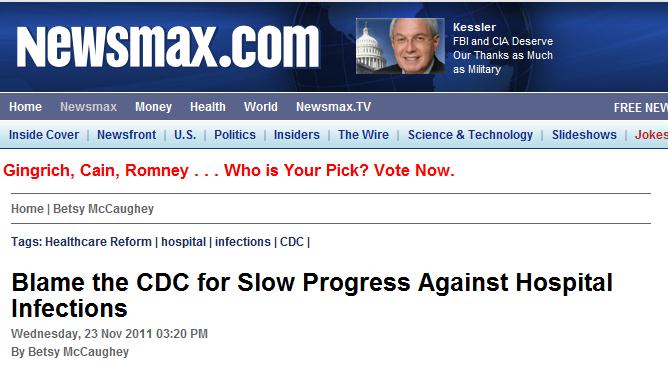
Last night, I stumbled across a link to this piece:


Somehow I read all the way through it before I saw who had written it. Then it all made sense. Like a bad penny, Betsy McCaughey, turns up yet again. Since it's a holiday and I would prefer to stay in a joyful mood, I won't write anything about her, but refer you here to see our previous postings about her.

So on this Thanksgiving Day, I'm thankful for the CDC. Over the course of my career, I have come to know many people who work there, particularly in the hospital infections group. They are simply a great bunch--smart, hard-working, dedicated people who do great work with little recognition. The CDC has been working in the area of healthcare associated infections for over four decades and it's difficult to imagine what healthcare epidemiology would look like today were it not for these folks.


Saturday, October 22, 2011

Some good news for a change...

Photo: Robert JR Graham.com
This week CDC announced progress made on reducing healthcare associated infections. Analyzing 2010 data from the National Healthcare Safety Network, CDC found:
  • A 33% reduction in central line-associated bloodstream infections (35% reduction in ICU patients and a 26% reduction in non-ICU patients). 
  • A 7% reduction in catheter-associated urinary tract infections throughout hospitals
  • A 10% reduction in surgical site infections
  • An 18% reduction in the number of people developing health care-associated invasive MRSA infections

Sunday, March 27, 2011

Pronovost on HAIs

Photo: Johns Hopkins Medicine
There's an interview with Peter Pronovost on reducing healthcare associated infections in tomorrow's Wall Street Journal. You can view it here.

Sunday, January 23, 2011

Aspirational goals

There's a paper in the February issue of Infection Control and Hospital Epidemiology by a group of investigators at the University of Pennsylvania. They set out to perform a systematic review of the literature to determine the proportion of healthcare associated infections that are reasonably preventable. Their determination was that 65-70% of central line associated bloodstream infections and catheter-associated urinary tract infections were reasonably preventable, and that 55% of ventilator-associated pneumonia cases and surgical site infections were reasonably preventable. Quick, someone call APIC--they're still targeting zero! I know, I know: zero is an aspirational goal. And I'm still aspiring to be a professional football player.

Addendum, 1/23, 9:55 AM:  I just ran across this article published yesterday in a California newspaper. Now here's a piece that's apropos, and one that tries to tell the other side of the story.

Friday, January 21, 2011

Learning to count...

There's an old joke about asking an accountant "what's 2+2?" and the accountant responds "what do you want it to be?"

Unfortunately, CDC has some creative math rules of its own. So for hospital epidemiologists, 1 + x = 1 when it comes to counting central line days. That is, for patients who have more than one central line, only one line can be counted per day for the denominator in calculation of central line associated bloodstream infection (CLABSI) rates. It's as if only one of the three central lines in the acutely ill ICU patient poses a risk to the patient. Magically, the other two are immune.

In the February issue of Infection Control and Hospital Epidemiology, there is a study by the Hopkins group that examined the effect of the one-catheter-per-day rule and found that counting only one catheter falsely overestimated their CLABSI rate by 36% in 3 surgical ICUs.

Two years ago, our group presented a very similar study at SHEA done in our medical and surgical trauma ICUs. We found that the CDC rule falsely overestimated our CLABSI rate by 20%.

In the era of mandatory public reporting of HAIs, it's imperative that everything be done to produce the most valid data for consumers. I'm baffled that CDC has been so slow to respond to these issues. The focus seems to be on validating surveillance using the methodology as is, rather than modifying the methodology to make it more valid.

Saturday, January 15, 2011

Bug-mobiles?

There's a new study in the American Journal of Emergency Medicine that caught my eye this morning. It asks the interesting question: are patients who present to the hospital via advanced life support (paramedic) transport more likely to develop HAIs than those who do not.

The design was a retrospective cohort which evaluated over 150,000 hospital admissions over a 5-year period at a hospital with a level 1 trauma center. The study found no difference in community-acquired infections between the two groups. However, patients arriving by ambulance were 1.4 times more likely to develop an HAI.

Since observational studies can be plagued with bias and confounding, we can't determine whether the ambulance transport led to the higher rates of HAIs. Nonetheless, as infection rates fall in hospitals, the identification of new groups at potential risk is important, since this can lead to the implementation of new interventions. As I begin to put together our annual report on HAIs, it's evident that we've picked the low-hanging fruit, and although rates of infections continue to fall, the slope of the curve is flattening. Thus, we need to return to the drawing board to develop new strategies.

Tuesday, January 11, 2011

Madame Necker lives on

Madame Suzanne Necker
Source: Wikimedia Commons
You are probably asking: Who is Madame Suzanne Necker? And what does she have to do with infection prevention? Well, she was the wife of a French finance minister who started a campaign in the late 1700s to limit the number of patients per hospital bed to 1. At that time, up to 8 patients shared a bed in French hospitals.

So the one patient-one bed standard came to be and has lived on. In 2006, over 200 years later, the American Institute of Architects Guidelines for Design and Construction of Health Care Facilities called for a new standard of one patient-one room. A 2008 commentary in JAMA outlined many reasons for the private room standard, including reduced potential for HAIs, reduction of patient transfers, enhanced patient throughput, and greater privacy for patients and families.

A new study in the Archives of Internal Medicine, looks at the acquisition of pathogens before and after the move from an ICU with multiple patients per room to a new ICU with all private rooms. Another hospital in the same city with the same infection control service and multi-bed rooms throughout the study period served as a comparator. The authors report that the acquisition of MRSA, VRE and C. difficile fell 54% after the move to the all private-room ICU. I think the study has a number of problems, which I won't belabor here, but will point out one curious finding that somewhat undermines the authors' conclusions--although the rate of MRSA acquisition fell after the move, the rate of MSSA acquisition did not.

Two years ago, all the ICUs at my hospital except one moved to a new tower with all private rooms, including our NICU. Clearly, it's easier to practice good infection prevention with patients separated nicely, though one downside that we noticed immediately was that it became much more difficult for our hand hygiene observers to collect as many hand hygiene observations from any single point of observation.

Bottom line: I think that private rooms probably do have an impact on reducing infections, though I don't think we have proven that yet. And whatever gains can be made by better design can probably be undone by poor compliance with hand hygiene.

Thursday, December 2, 2010

Needed: CLABSI tune-up

We have blogged before about problems with NHSN HAI case definitions. For central line associated bloodstream infections (CLABSI), a major problem is the lack of specicity of the definition, which many believe leads to an overestimation of the rate of these infections. In this month's Infection Control and Hospital Epidemiology there is a commentary on the CLABSI definition by Dan Sexton that is well worth reading. He proposes some simple changes to the definition that would make a big difference in improving specificity.

Saturday, November 6, 2010

Headline: "Hospital Accused of Putting Patients at Risk to Cut Costs"

The Milwaukee News reports that 5 patients at a local hospital are suing the hospital after acquiring infections following surgery. Lawsuits involving nosocomial infections aren't unique, but the argument at play in these cases appears to be, and should be of great interest to hospital administrators and the infection prevention community. The plaintiffs claim that the hospital cut positions in its infection control unit as part of a cost savings plan while building a $400 million new facility. This begs the question: what is the appropriate level of resources hospitals should provide for infection prevention? There is no current national standard to answer this question. But I wonder if the public would be better served if legislative activity focusing on HAIs mandated resources (e.g., IPs/100 beds) rather than particular strategies, such as active surveillance for MRSA.

Wednesday, October 27, 2010

Holy Superlatives, Batman! Hospital-acquired infections have significant economic costs!

1935 Dollar

There is a well done study out in Medical Care by Rebecca Roberts et al. from Stroger/Cook County that assesses the attributable costs of HAIs in a cohort of patients from 2000.  What sets this paper apart is the careful attention they paid to design and analysis methodology.  Just to paste from the abstract, they used "ordinary least squares linear regression and median quantile regression, Winsorizing, propensity score case matching, attributable LOS multiplied by mean daily cost, semi-log transformation, and generalized linear modeling. Three-state proportional hazards modeling was also used for LOS estimation. Attributable mortality was estimated using logistic regression." 

Thursday, September 23, 2010

Why I took the job? Low HAIs and high flu vaccine compliance!

Dr. Churchwell
Delaware's only children's hospital, Alfred I. duPont Hospital for Children, just announced that Dr. Kevin Churchwell will become chief executive officer in December.  I'm not sure even why I read the article, but what caught my eye was why he said he took the job:

Churchwell said the new (renovation) project was one issue that factored into accepting the job. He also was impressed with the quality of care delivered at duPont, which has low hospital-infection rates compared with other local and national hospitals. It also has high vaccination rates for the flu among its health care workers.

"They have a great safety infrastructure," Churchwell said. "A.I. is a leader in that, and they need to step out and teach other hospitals how it's done. That will make a big difference."

Something is up. Not only is it great that a CEO has HAIs as a major priority, which is hopefully becoming more common, but also that he selected the job based on the quality and safety of the hospital.  Perhaps it's because he's a pediatric critical care doc. Either way, it's pretty cool.


Delaware online announcement

OSHA! OSHA! OSHA!

  In many parts of the country, as rates of COVID-19 are declining and vaccination coverage is increasing (albeit with substantial variati...